


Fernando Alonso: The Iconic Journey of an F1 Legend
Triumph at Interlagos
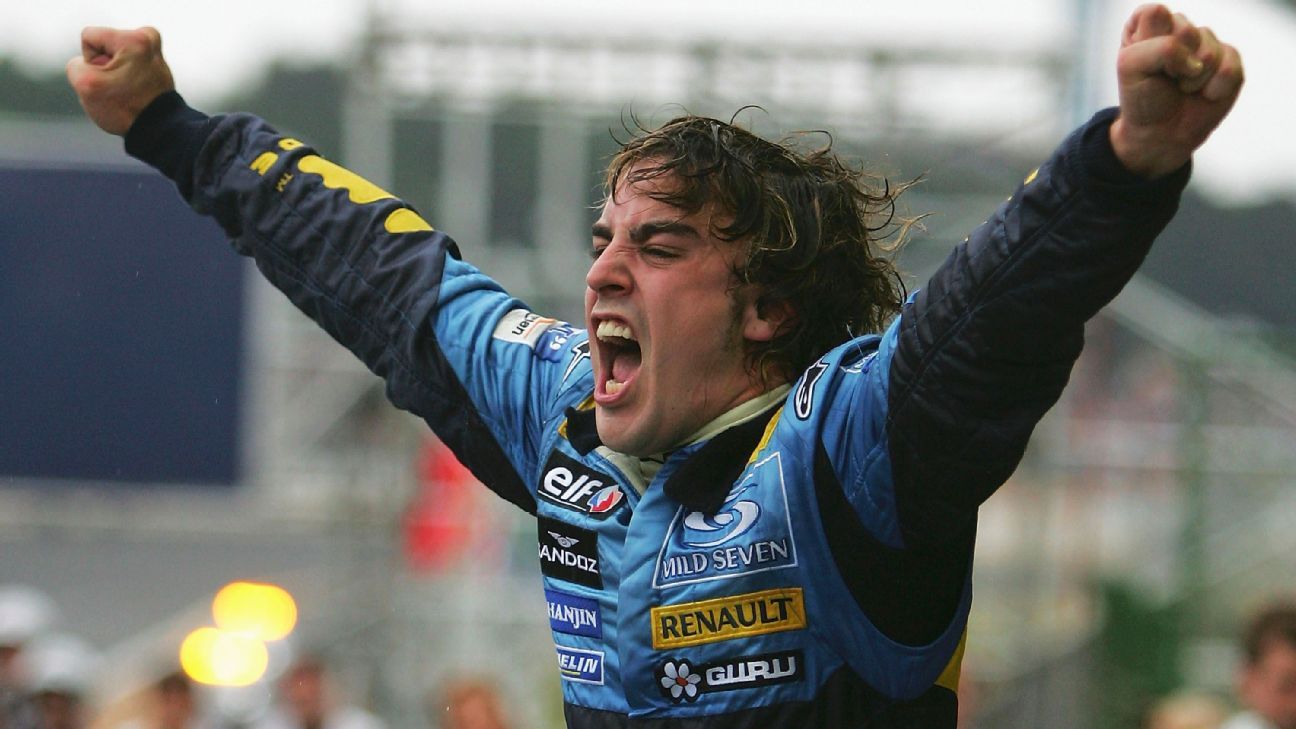
On September 25, 2005, Fernando Alonso made history by clinching his first Formula 1 World Championship at the young age of 24. Climbing onto the front of his blue and yellow Renault, he exuded a wild mix of elation and relief as he pumped his fists into the air and screamed, “Come on! Come on!” This iconic moment not only signified the start of Alonso’s reign but also marked a pivotal shift in the F1 landscape. Alonso’s triumph came with two races to spare, dethroning the legendary Michael Schumacher, who was seeking his sixth consecutive title at the time.
Alonso’s journey from a karting enthusiast in Oviedo, Spain, to World Champion was anything but straightforward. He was not the conventional choice, considering that Spain’s motorsport fame primarily revolved around two-wheel racing. Yet, his determination and skill broke down barriers. Just two years earlier, he had become Spain’s first F1 victor, capturing the racing world’s attention and igniting aspirations across the nation.
The Emotional Weight of Victory
Recalling that groundbreaking day, Alonso vividly describes his emotions during the last laps of the race. “In my mind was all my karting days, my single-seater career… all concentrated on that moment of joy.” His celebration was a culmination of years of hard work, familial sacrifices, and the relentless quest to reach the pinnacle of motorsport.
While the glimmering trophy and the festivities that followed were significant, it was the sheer relief and joy of that victorious scream that remains etched in Alonso’s memory. He describes it as “maybe 20 years of my life concentrated in those 10 seconds of celebration,” emphasizing the psychological toll of the championship chase.
A Legacy of Inspiration
Alonso’s victory had profound effects on motorsport back home, inspiring a generation of Spanish drivers. Among them is Carlos Sainz, who began sharing the grid with his idol in 2015. For Sainz, Alonso’s rise was monumental: “He was a big culprit for me falling in love with the sport,” he exclaimed. Beyond just personal admiration, Alonso fueled a significant increase in participation in karting, with championships filled to capacity as aspiring drivers aimed to emulate his success.
Spain, once indifferent to F1, transformed into a nation of fervent supporters. Industrial figures in the sport, like Flavio Briatore, who managed Alonso early in his career, reflect on the nationwide awakening brought about by Alonso. “Fernando was everything there,” Briatore quips. “Before him, there was never a big Formula 1 driver.”
The Essence of a Champion
Alonso’s driving prowess is frequently cited by peers as unrivaled. He is celebrated not just for his competitive spirit, but for a well-rounded skill set that makes him one of the best drivers of the modern era. Even in the face of adversity and the pressures that come with competing at the highest level, Alonso’s commitment has remained unwavering.
Over his career, he has faced numerous challenges, including missed titles with McLaren in 2007 and with Ferrari in 2010 and 2012. However, he has also experienced moments of brilliance, such as his ventures beyond F1, including victories at the Indy 500 and Le Mans, further solidifying his status as a versatile racing figure.
A Complex Legacy
Despite his many achievements outside traditional F1 accolades, there’s a lingering discussion about Alonso’s standing among the greats of the sport. While he’s garnered praise for his talent, many feel he hasn’t been sufficiently rewarded in terms of championship titles. As he approaches his mid-40s, the prospect of adding to his substantial career stats grows increasingly uncertain, leaving fans to ponder what the future holds.
Fellow racers and insiders alike continually express their admiration for Alonso’s tenacity and skill. Max Verstappen, the current championship leader, remarked on Alonso’s influence, commenting that “there are a lot of people who never won a race in Formula 1 who perhaps could have won or should have won.” It’s a reminder that the racing world is often shaped as much by circumstance as it is by talent.
The Racing Spirit
Alonso’s drive to continue competing in F1 reflects his undying passion for the sport. His involvement in various racing disciplines showcases a desire to prove that he belongs among the elite. In a recent season, he joined Aston Martin, drawn in by the prospect of working on a project he believes has championship potential.
Even in a sport operating under the pressures of time and performance, Alonso’s approach reminds us that racing is not just about wins and titles. It’s about the relentless pursuit of excellence, personal growth, and a connection to the sport that tends to transcend generational divides.
An Unfinished Symphony
As Alonso navigates the latter part of his career, one thing remains clear: his legacy is multifaceted. He is recognized not only as a two-time champion but as a relentless competitor whose journey has inspired countless others. His reflections suggest a nuanced understanding of success, underscored by the acknowledgment that luck and timing inevitably shape a racer’s narrative.
With each race, Alonso continues not just to compete, but to etch his identity deeper into the annals of Formula 1, embodying a spirit that resonates with fans and fellow competitors alike, serving both as a role model and a reminder of the heights that can be achieved through tenacity and skill.