


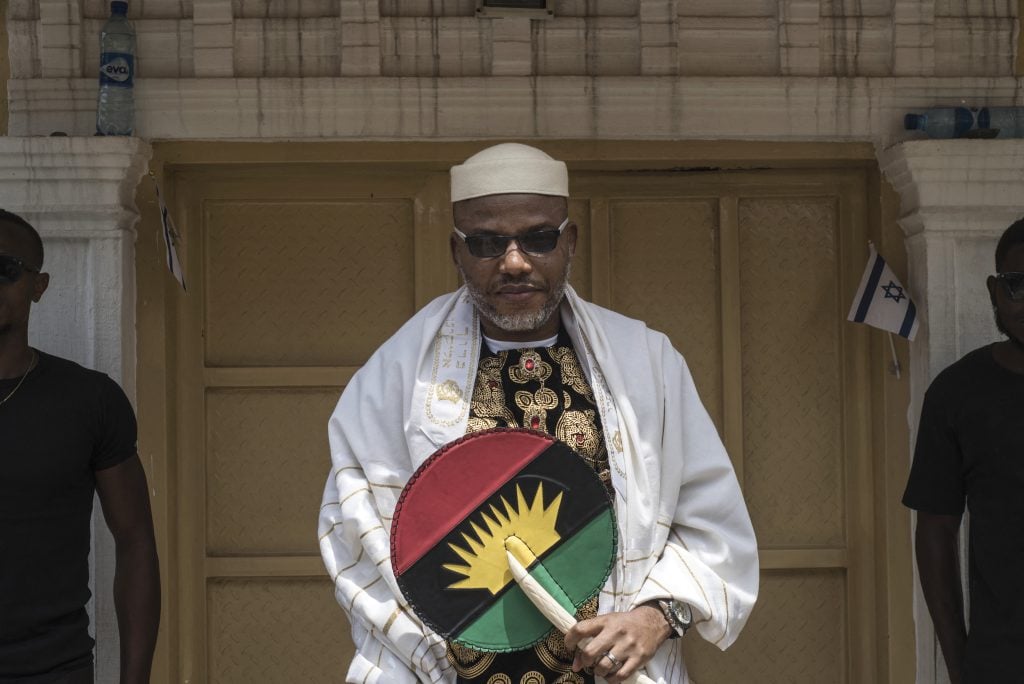
Nnamdi Kanu Sentenced: Implications for Nigeria and the Quest for Biafra
On a Thursday that sent ripples through the political landscape of Nigeria, a court sentenced Nnamdi Kanu, a prominent separatist leader advocating for the creation of an independent Biafran nation, to life in prison on terrorism charges. Kanu is known for his leadership of the Indigenous People of Biafra (IPOB), a group that has been designated as a terrorist organization by the Nigerian government. The implications of this verdict are profound, affecting not only Kanu and his followers but also the broader socio-political environment in Nigeria.
The Court’s Ruling
Judge James Omotosho presided over the case and stated that prosecutors had successfully demonstrated that Kanu’s broadcasts and directives incited violent attacks against both security forces and civilians. He emphasized that Kanu’s intentions were clear: his rhetoric was designed to provoke violence, which the court classified as acts of terrorism carried out by his followers. This stark characterization elevates Kanu’s actions from mere political dissent to criminal activity with severe consequences.
Global Context and Religious Persecution Claims
Kanu’s sentencing coincides with a critical moment for Nigeria, as international scrutiny intensifies regarding issues of religious persecution. Recently, U.S. President Donald Trump threatened military action, citing mass killings of Christians in Nigeria. This assertion has been a point of contention, particularly as Kanu sought to leverage Trump’s assertions by writing to him, linking his case to allegations of broader violence against Christians. His IPOB faction has even organized pro-Trump rallies, highlighting the complex web of international politics intersecting with local grievances.
On the very day of Kanu’s sentencing, the U.S. House Foreign Affairs Committee convened to discuss Trump’s designation of Nigeria as “a country of particular concern” due to ongoing allegations of religious persecution. Congressman John James connected Kanu’s trial to issues of religious repression, arguing that it exemplifies a trend of targeting Christians within Nigeria. His comments underscore a broader narrative where political repression and religious persecution intertwine, raising alarms about the state of democracy in the country.
Kanu’s Journey to the Courtroom
Kanu’s road to this life sentence has been fraught with dramatic turns. He was abducted by agents in 2021 while in Nairobi, Kenya, and forcibly returned to Nigeria, a move that enraged many who viewed it as unlawful. His broadcasts had been controversial, infamously suggesting that former President Muhammadu Buhari had died in 2018 and was replaced by a Sudanese impostor. Charged with treasonous felonies and terrorism, Kanu argued that his armed group, the Eastern Security Network, was formed to protect the Igbo people from attacks by predominantly Muslim Fulani herders.
The legal journey has been tumultuous. In 2022, the Court of Appeal ruled in Kanu’s favor, dismissing charges based on procedural errors during his extradition. However, this ruling was overturned by the Supreme Court the following year, allowing for a new trial that ultimately led to his life sentence.
Historical Context and Relevance
The quest for an independent Biafra is rooted deeply in Nigeria’s turbulent history. The Biafran War, fought from 1967 to 1970, resulted in immense human suffering, leading to the deaths of over a million people due to famine and conflict. While the war officially concluded over fifty years ago, grievances among the Igbo people persist. Many claim systemic discrimination and marginalization, sentiments that Kanu has harnessed to galvanize support among younger generations who have no firsthand experience of the war but feel the rippling effects of its legacy.
Kanu’s role as a voice for these historical grievances has resonated with many Igbos, further complicating an already sensitive national narrative. His advocacy for Biafran independence taps into deep-rooted feelings of injustice, fueling ongoing unrest in the southeastern region of Nigeria.
Reactions and Future Implications
The reactions to Kanu’s sentencing are likely to be as varied as Nigeria itself. While the Nigerian government may see this as a necessary step to restore order and compliance, many within the IPOB and its supporters view it as a continuation of systemic oppression against the Igbo people. As diplomatic tensions rise, particularly with the U.S. government, the political landscape may shift dramatically in the era of Kanu’s imprisonment.
The implications of this case extend beyond legal boundaries, threading through cultural, religious, and international relations. As Nigeria grapples with its complex identity and the aspirations of its various ethnic groups, Kanu’s life sentence may very well be a flashpoint in the ongoing narrative of resistance, identity, and the quest for autonomy amongst the Igbo.