


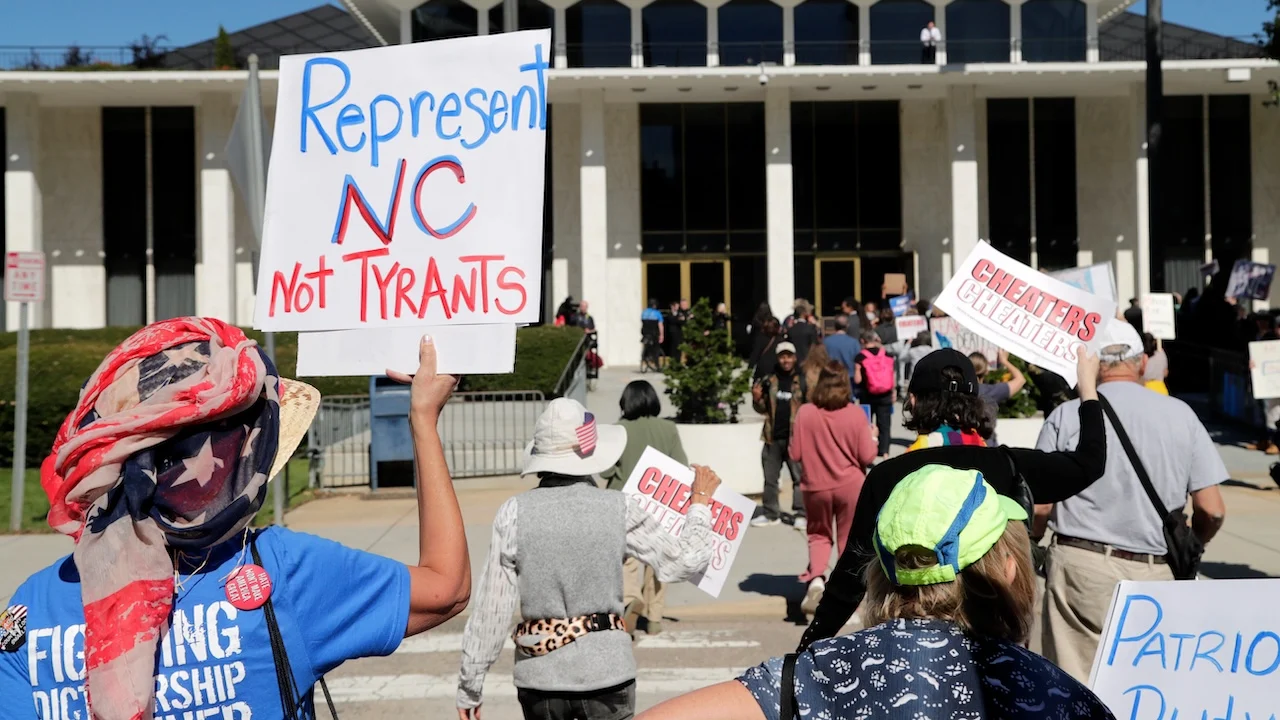
North Carolina’s Congressional Map Change: Implications and Reactions
Introduction to the Redistricting Situation
Recently, a federal three-judge panel in North Carolina greenlit a newly drawn congressional map designed to aid Republican candidates in the upcoming elections, aligning with President Donald Trump’s nationwide redistricting strategy ahead of the pivotal 2026 elections. The state’s only swing seat, currently held by Democratic U.S. Rep. Don Davis, is at the center of this political maneuvering.
Background on the 1st District
The 1st District, which covers over 20 counties in northeastern North Carolina, has been represented by Black members of Congress for more than three decades. This area’s demographics and political history highlight its significance in the ongoing redistricting battle, as it represents a critical opportunity for Republicans seeking to increase their representation.
Court Decisions and Political Strategy
The trio of judges unanimously dismissed requests for a preliminary injunction following a hearing in Winston-Salem, reinforcing the Republican majority’s grip on the congressional map. This decision arrives on the heels of prior rulings allowing GOP lawmakers’ 2023 maps, which were instrumental in their gaining three additional congressional seats in the last election cycle.
Trump’s Redistricting Influence
Breaking with tradition, Trump encouraged GOP-led states to redraw congressional maps mid-decade. This tactic aims to capitalize on perceived vulnerability in the Democratic ranks while ensuring Republican strongholds. Democrats, needing only a few seats to regain control of the House, view this strategy as a direct threat to their objectives.
Countermeasures by Democrats
In response to the GOP-driven redistricting efforts, Democrats have also begun to take steps to reshape district lines in their favor. Recent developments in states like California, where voters have adopted new districts beneficial to Democratic candidates, indicate an ongoing tug-of-war over electoral control.
Legal Challenges and Responses
The recent court ruling has ignited debate among stakeholders. Supporters of the GOP map argue that it reflects the will of the North Carolinian voters, particularly those who supported Trump in the last three elections. North Carolina Republican Senate leader Phil Berger commended the ruling for resisting what he termed as radical attempts by the left to manipulate the electoral process.
In contrast, critics argue that the new map represents one of the most gerrymandered configurations seen in the state’s history. Bob Phillips, Executive Director of Common Cause North Carolina, voiced concerns that the ruling undermines voter equity, particularly targeting communities that have consistently supported different candidates than the majority party.
Racial and Constitutional Implications
The legal challenges concerning the map highlight multiple constitutional concerns. Plaintiffs, including the NAACP and Common Cause, argue that the new configuration disproportionately impacts Black voters, effectively diluting their representation in the 1st District. They assert that the redrawn lines breach the 14th Amendment’s one-person, one-vote guarantee and potentially engage in racially discriminatory practices.
Republican Justifications
Attorneys representing the Republican lawmakers contend that their redistricting motives are purely political rather than racial. They assert that the maps are part of a nationwide effort related to redistricting that is entirely permissible under existing Supreme Court precedents.
Current Political Landscape in North Carolina
With 10 out of the state’s 14 House seats currently occupied by Republicans, the latest redistricting aims to flip yet another seat in favor of the GOP. The political landscape is evolving, particularly as new candidate filings for the 2026 elections approach.
Demographic Changes in the 1st District
One of the most contentious aspects of the newly drawn map is the alteration of the Black voting-age population in the 1st District, which is projected to decline from 40% to 32%. Critics of the mapping strategy are concerned that this shift could significantly impact Democratic prospects in future elections.
Strategic County Realignment
The recent redistricting also involved transferring counties with substantial Black populations to the neighboring 3rd District, currently represented by Republican Greg Murphy. This realignment appears strategically designed to bolster Republican chances in both districts, a move that has raised eyebrows and sparked further legal scrutiny.
Wrapping Up the Discussion
As the political fallout from this redistricting effort unfolds in North Carolina, ongoing litigation, and responses from both sides ensure that this issue will remain at the forefront of political discourse as the 2026 elections approach. The implications of these strategic maneuvers will undoubtedly shape the electoral landscape, and continued developments promise to influence the larger narrative of American politics.