


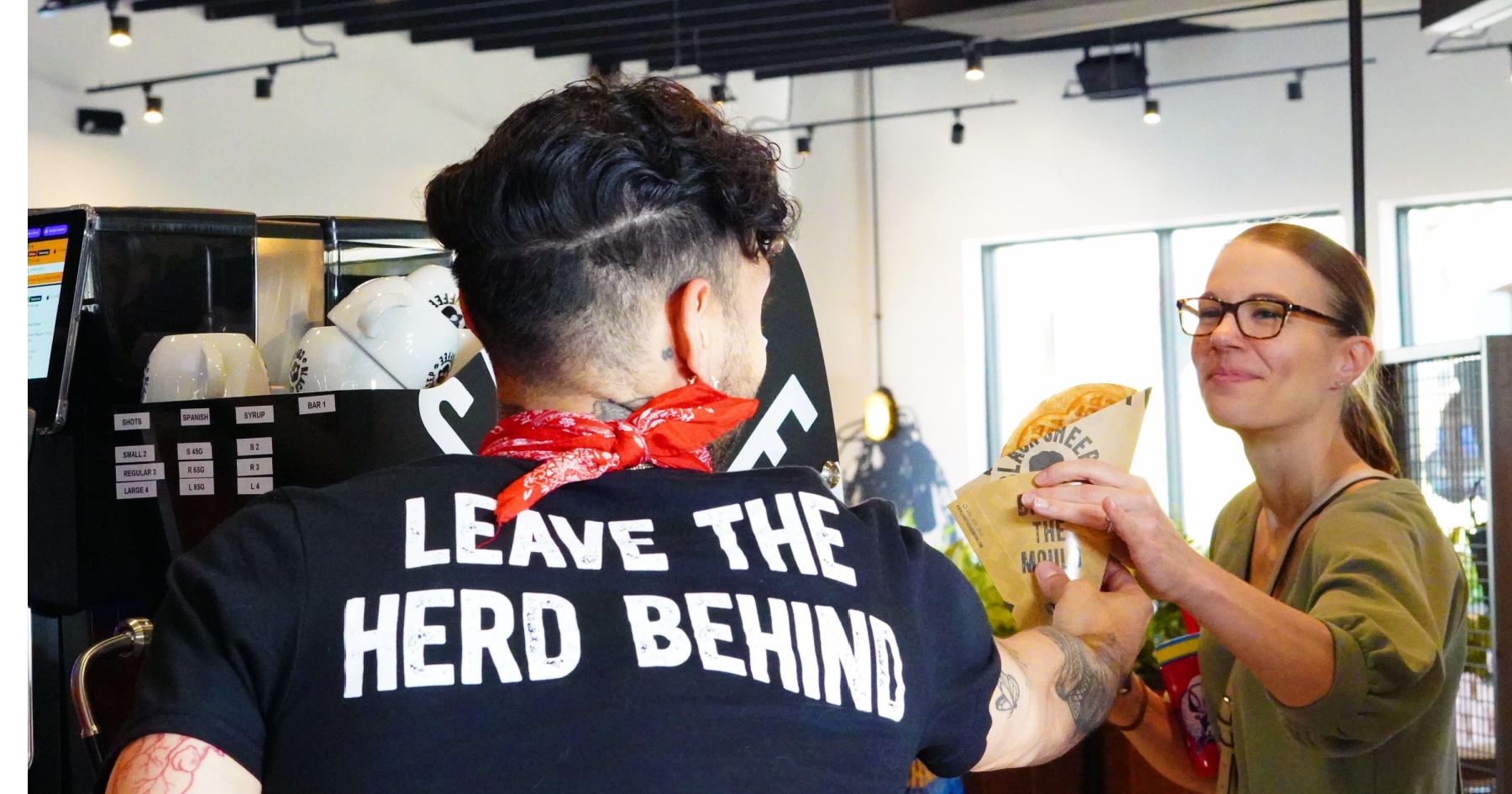

Black Sheep Coffee has about 125 units in the United Kingdom. The founders have moved to the U.S. with plans for franchise expansion. | Photo courtesy of Black Sheep Coffee.

When international foodservice chains come to the U.S. for the first time, they typically make their debut first in New York City (or Los Angeles).
But Black Sheep Coffee, a drive-thru and coffee shop brand born in the United Kingdom, decided to do things differently.
Black Sheep opened first in the Dallas area last year with the goal of seeding the Sun Belt, where the population is growing, said co-founder Gabriel Shohet, who recently moved to the U.S.
The coffee chain now has four units in Texas, with two more scheduled to open before the end of the year. Another location has also opened in Miami, where Black Sheep has established a U.S. headquarters.
The brand is planning franchise growth across the country. Shohet said the Texas and Florida territories are sold, and now the chain is seeing interest from franchisees in Georgia, South Carolina, Tennessee, and Arizona.
Developed about 12 years ago in London, Black Sheep has been on a growth tear in the U.K. and now is entering the Middle East. The chain has 125 units across the U.K., about 45 of which are company-owned, with another five franchised units coming to Gulf Cooperation Council nations around the Persian Gulf.
@jaaaaazzzz_96 One of my favorite coffee shops in the Dallas area. It’s open till 10pm and it really cozy! It has a lot of drinks, food, and sandwiches on the menu! I got the strawberries and cream matcha and it was 10/10! 🤭 @BlackSheepCoffee #dallas
#matchatok
#matcha
♬ Guilty as Sin x About You – molanazhr
Shohet, who is originally from Switzerland, co-founded the coffee concept with Eirik Holth roughly 12 years ago. The two friends had quit their “boring office jobs” on the same day (Holth was in infrastructure and Shohet was in tech) and moved to London with the idea of starting a coffee shop.
“We had no idea what we were doing,” said Shohet. “We thought, it can’t be that hard to start a coffee shop.”
“We were very naive,” he added.
With only about $20,000 (or probably the equivalent in British pounds) in savings, they couldn’t afford a lease. So they set up a trestle table on a street corner and spent two years shilling coffees until they had earned enough to open a brick-and-mortar.
Now, of course, Shohet is very aware of the “sweat and tears” it takes to build a brand.
“It’s a very, very iterative process of trying new things and scrapping old ideas, and implementing new ones,” he said. “But it’s also been a really fun journey.”
Black Sheep’s primary point of differentiation is the type of coffee used. Most coffee brands use arabica beans, which have a sweeter flavor but are harder to grow, so they tend to be more expensive.
Black Sheep uses robusta beans, which can be harsher and bolder, but the plants are hardy and have a higher yield. They also have a higher caffeine content, though the result in the cup varies by the brewing method.
For espresso-based drinks, which account for about 85% of Black Sheep’s coffee sales, the robusta beans work well. They are sourced from around the world and roasted in the U.S. (Shohet said tariffs are not really an issue.)
The move has enabled Black Sheep to offer a more value-positioned menu.
“We have a slogan that says, ‘Never fear the competition. Open right next door instead,’” said Shohet. “And we’ve done that in the U.K., where we just open right next to Starbucks or the big incumbents, which in the U.K. are Costa and Caffe Nero, and we try to shut them down, basically.”

Black Sheep Dallas opened in June last year. | Photo courtesy of Black Sheep Coffee.
But coffee in the (still largely tea-drinking) U.K. is one thing. Americans love their cup of joe, even if that cup is increasingly served iced and flavored, foamed and topped with whipped cream.
Shohet is well aware of the far-more-crowded coffee scene in the U.S., with the ubiquity of Starbucks and the rapid growth of chains like Dutch Bros. and 7 Brew.
You just have to be confident that you can offer something better, he said.
“Better product quality, better service, better customer experience, better tech, a better app that can self-order,” he said. “And if you can be better at all these facets, then you’re going to actively take market share away from the incumbents.”
At Black Sheep, matcha is also a big seller, accounting for about 18% of total sales. The chain sources a Japanese ceremonial-grade matcha, rather than a more commonly used commercial type from China, which Shohet said tastes “grassy.”
Matcha is “a massive category for us,” he said, with top sellers like a Blueberry Iced Matcha and seasonal options, like the recent Ube Matcha for Halloween.
Black Sheep also offers various pastries along with unique hand-held Norwegian waffles, which are a bit different from bigger Belgian-style waffles. The Norwegian version can be ordered with various toppings, typically sweet, though there’s also the traditional Norwegian brown cheese version.
So far, Shohet said the chain has grown with private investors, which include NBA player Kristaps Porzingis, former Coca-Cola Canada president Bill Schultz, and various professional poker players. (Shohet said he dabbles in poker tournaments himself, but “I’m nowhere near their level.”)
The chain has turned down offers from private equity, he said.
“Eirik and I wanted to retain the independence of the brand. At times, it was hard because we needed cash,” he said. “But when you look back today, we’re really thankful that we managed to do it that way, because it means, I reckon, I still control the business, and we want to build a global brand long-term. And it’s very hard to do that if you have shareholders on board who have three- to five-year horizon on their investment and want to do a quick flip of their shares.”