


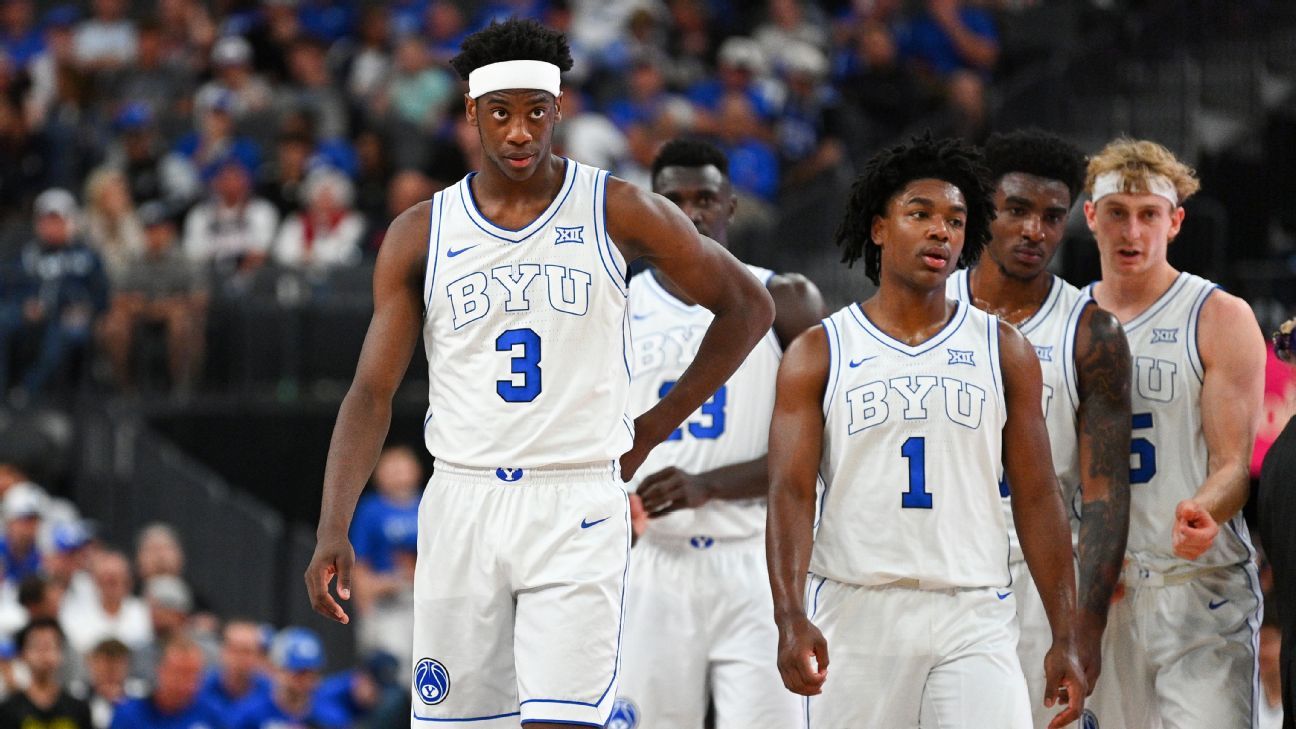
Navigating Expectations: BYU Basketball’s Strategic Blueprint for Success
As the 2025-2026 college basketball season heats up, the Brigham Young University (BYU) Cougars are poised to make a significant impact, led by their star recruit AJ Dybantsa and a slew of new talent. The team, fresh off a Sweet 16 appearance, is aware that maximizing its potential means more than just having the best player; it requires a well-rounded strategy to build a winning roster around that talent.
Step 1: Recruit an Elite Guard
Recognizing the need for a backcourt star to complement Dybantsa, BYU’s coaching staff made recruiting a top-tier point guard a priority. Initially, the Cougars thought they might depend on Dallin Hall, who was expected to return. However, after Hall entered the transfer portal shortly after their Sweet 16 exit, the team shifted its focus and zeroed in on Baylor’s Robert Wright III.
Kevin Young, BYU’s head coach, underscored Wright’s immediate appeal: “It was pretty clear that he was the best point guard in the portal.” Wright emerged as one of the most dynamic freshmen in the country, having displayed exceptional skill against the Cougars when he scored 22 points with 6 assists in their previous matchup.
Alongside Dybantsa, who is pegged as a potential No. 2 pick in the 2026 NBA draft, and All-Big 12 standout Richie Saunders, Wright forms a powerful trio. Saunders also proved vital to the team’s aspirations, showcasing his proficiency as a scorer during crucial moments last season.
Step 2: Find Role Players to Complement the Big Three
While landing a star player is essential, the Cougars understood that past examples show the importance of surrounding elite talent with complementary players. Kevin Young cautioned, “One thing that gets really lost at every level is roster composition.”
The team looked internally for continuity, bringing back key contributors like Keba Keita, renowned for his defensive prowess, along with Dawson Baker and Mihailo Bošković. Retaining experienced players was seen as a valuable asset in a landscape increasingly affected by high-profile transfers.
The Cougars also scoured the transfer portal for additional talent. They ended up securing Southern Illinois’ Kennard Davis Jr., a versatile 3-and-D player who averaged over 16 points per game last season. His addition was aimed at providing the necessary floor spacing to allow Dybantsa and Wright to operate effectively.
With new additions like Washington transfer Dominique Diomande and others, BYU was looking to create a well-rounded lineup while maintaining defensive strengths. This balanced approach has yielded impressive results, placing BYU among the best in offensive efficiency early this season.
Step 3: Develop Chemistry
Even with the right talent, the cohesion of the team on the floor is pivotal. BYU’s big three have showcased promising individual statistics, with Dybantsa averaging 19.4 points, Wright contributing 16.9 points and 6.3 assists, and Saunders netting 18.9 points per game. However, early season play suggested that finding the right rhythm would take time.
Head coach Young acknowledged the need for rapid chemistry construction, especially with a new roster. A pivotal moment came during a near-comeback against UConn after being down by 20 points, signaling growth and adaptability. Furthermore, their emphatic victory against Wisconsin not only demonstrated the potential of the trio but also showcased effective ball movement, with multiple assists leading to scoring opportunities.
As the season progresses, BYU will return to its home base, where they will have several matches to refine their offensive systems before heading into conference play. With Dybantsa, along with multiple All-America candidates, the pressure is on the team to capitalize on this unique opportunity.
In a nutshell, BYU’s journey this season hinges on meticulous roster construction, the strategic recruitment of players, and above all, the cultivation of team chemistry. Balancing talent with teamwork will be crucial as they strive for success in an increasingly competitive college basketball landscape.