


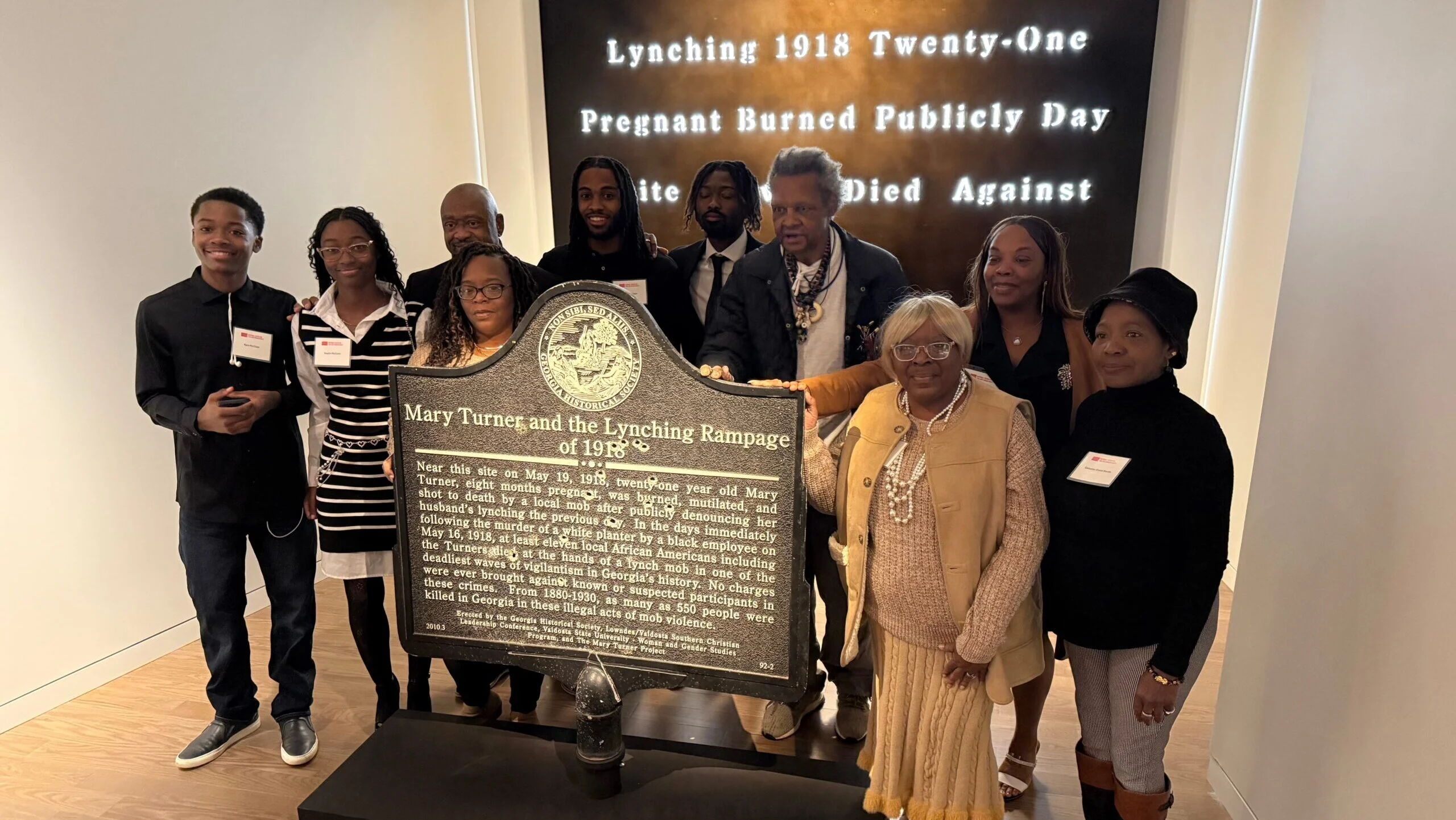
In a poignant reminder of America’s turbulent history, a historical marker commemorating the 1918 lynching of Mary Turner has found its rightful place in the National Museum for Civil and Human Rights in Atlanta. Unveiled on December 8, this exhibit comes after years of vandalism, showcasing the complexities of memory, history, and the ongoing struggle for justice.
The stark reality of the events surrounding Mary Turner’s death is harrowing. Mary was eight months pregnant when she was slain by a white mob furious at her demand for justice following the lynching of her husband, Hayes Turner. The brutal killings didn’t stop with the Turners; in total, at least 10 Black individuals lost their lives in this rampage. Yet, attempts to erase the memory of these atrocities persisted in rural southern Georgia, where many have sought to downplay this dark chapter in history.
The Georgia Historical Society marker, now fully restored, bears the scars of its turbulent past. It is pocked with bullet holes and cracked from the impact of an off-road vehicle. Its text poignantly recounts the horror: “Mary Turner, eight months pregnant, was burned, mutilated, and shot to death by a mob after publicly denouncing her husband’s lynching the previous day.” This chilling account serves not only as a record of violence but also as a testament to the systemic racism pervasive in the state, where many lynchings went unpunished.
Among the notable features of the exhibit is the way it connects past and present. Each bullet-riddled word from the marker is projected on a wall, accompanied by the voices of Mary Turner’s descendants, including her great-granddaughter Katrina Thomas. Thomas expressed a bittersweet relief at the vandalism, suggesting that it has inadvertently amplified the story of her great-grandmother: “Millions of people are going to learn her story. That her voice is continuing years and years after, it shows history does not disappear. It lives and continues to grow.”
The investigation into the lynchings of 1918 thrust individuals like Walter White into the spotlight. A pivotal figure in the civil rights movement, White founded the Georgia chapter of the National Association for the Advancement of Colored People (NAACP). His commitment to justice led him to interview eyewitnesses and expose the perpetrators, detailing his findings in a report published in the NAACP’s magazine, The Crisis. His work was crucial in bringing national attention to the atrocities occurring in Georgia, a state notorious for its lynching history.
The Equal Justice Initiative (EJI) provides chilling context for the events of 1918. Their extensive catalog reveals over 4,400 documented lynchings in the United States from Reconstruction through World War II, with Georgia among the worst offenders. In response to this grim reality, the EJI has erected monuments and placed markers across the nation, including in Montgomery, Alabama, where a significant memorial stands in honor of all lynching victims.
As a direct response to the public outcry following the Turners’ lynching, the first anti-lynching legislation was introduced in 1918. This legislative effort, fueled by the murders of Mary and Hayes Turner, progressed to the House in 1922 before being stalled by Southern senators. It would take another century before lynching was finally designated a federal hate crime in 2022, reflecting the slow march toward justice in America.
The vandalism of the original marker symbolizes an ongoing struggle against the injustices that plagued Mary Turner’s life and death. “The same injustice that took her life was the same injustice that kept vandalizing it, year after year,” stated Randy McClain, Turners’ great-grandnephew. McClain, who grew up in the same area without knowing the full extent of his family’s history, shared a profound sense of understanding and resolution as he experienced the exhibit for the first time.
In the safe space of the museum, McClain felt a sense of closure, noting, “She’s now finally at rest, and her story can be told. And her family can feel some sense of vindication.” This exhibition not only memorializes Mary Turner’s life but also serves as a call to confront the uncomfortable truths of American history, encouraging visitors to reflect on the legacies of racism and injustice that continue to shape society today.