


Engaging Holocaust Narratives Through 3D Technology
Last month, the Tucson Jewish History Museum & Holocaust Center (TJMHC) unveiled a groundbreaking initiative called “Intimate Histories in 3D,” revolutionizing how visitors interact with the stories of Holocaust survivors. This innovative project harnesses volumetric capture technology, transforming the narratives of survivors into three-dimensional recordings accessible on tablets and personal devices.
The project was developed in collaboration with the University of Arizona Center for Digital Humanities, bringing to life the testimony of Holocaust survivors residing in Southern Arizona. Ten local survivors, along with two second-generation survivors, participated in this initiative, ensuring that their experiences and memories are preserved for future generations.
The Importance of Survivor Testimonies
Andrew Schot, a 94-year-old survivor from Amsterdam, emphasizes the significance of this project by stating, “This project keeps us alive for years after we are no longer here.” His statement reflects a broader sentiment among survivors— the urgency to document their experiences before it’s too late. QR codes throughout the Holocaust Center guide visitors to these immersive recordings, linking powerful personal testimonies to various exhibits.
One poignant example is the 3D recording of Rosie Kahn, a second-generation survivor and museum docent. Positioned near the “Suspended Lineage” exhibit, Kahn’s 3D image allows visitors to engage deeply with her narrative. She invites audience members to look up at photographs of family members lost during the Holocaust. Her reflections highlight the ripple effect of loss— “When you look up there… you realize that it’s way, way more than six million people that were really destroyed in the Holocaust.”
A Technological Advancement
Understanding the importance of engaging younger generations, TJMHC Executive Director Lori Shepherd describes the 3D project as a novel medium for presenting and preserving survivor testimonies. By utilizing state-of-the-art technology, the museum aims to transcend traditional storytelling methods. The youngest Holocaust survivors are now in their 80s, underscoring the urgency of this initiative.
With the support of educators, such as Molly Dunn from Jewish Philanthropies of Southern Arizona, the project serves not only as a remembrance tool but also as a vital educational resource. Dunn notes that seeing a survivor tell their story in three dimensions makes the history feel relevant, connecting it to contemporary issues, such as the ongoing fight against antisemitism.
The Creative Process Behind Volumetric Capture
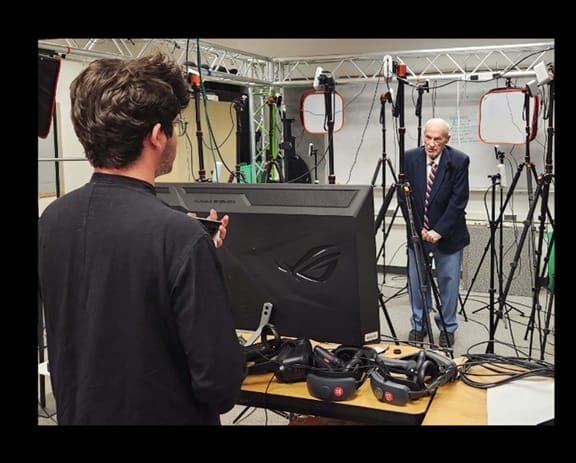
The technical process of creating these 3D recordings involves surrounding a participant with depth-sensing cameras. Bryan Carter, the director of the University of Arizona Center for Digital Humanities, explains that this technology allows for an immersive experience where visitors can engage with survivors as if they were present in front of them.
Unlike holograms utilized in other museum settings, which may respond to pre-scripted questions, Tucson’s approach focuses on a more natural storytelling experience. By opting for shorter, spontaneous recordings, the project caters to casual visitors, ensuring accessibility while maintaining personal connections to the narratives.
Voices of Resilience
Among the participants is Bertie Levkowitz, born in 1942 in the Netherlands and hidden by non-Jewish neighbors during the Holocaust. She shares her thoughts on firsthand testimonies, stating, “When you can get first-hand information, original source, that is the most meaningful.” This personal touch is at the heart of the “Intimate Histories in 3D” initiative, fostering connections between young visitors and the weight of historical events.
Sidney Finkel, another featured survivor, has also been instrumental in garnering support for this project. His doctor, Dr. Gary Monash, funded the 3D recordings as part of a broader commitment to preserving survivor stories, showcasing the community’s dedication to remembrance and education.
Continuous Refinement and Visitor Experience
As the project progresses, museum staff are continuously refining how they assist visitors in accessing these 3D recordings. Feedback during the beta phase will help enhance the engagement experience, ensuring that the stories are not only told but felt deeply by those who encounter them.
The overall aim of the “Intimate Histories in 3D” project is clear: to create a compelling dialogue between the past and present, forging an emotional connection that resonates beyond the confines of the museum walls. These 3D testimonials represent a vital step in education and remembrance, underscoring the importance of survivor stories and the necessity of preserving them for future generations.