


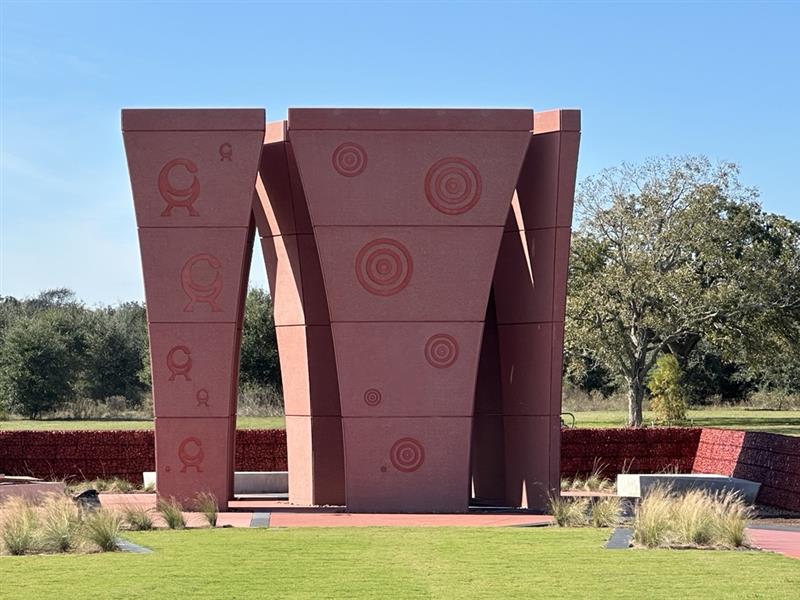
Honoring Heritage: The African American Heritage Monument in Kendleton
Located about 45 miles southwest of Houston, the quaint city of Kendleton holds a significant piece of history. Founded by formerly enslaved people after the Civil War, Kendleton is not just a dot on the map but a vibrant emblem of resilience and community. Recently, a monumental project has emerged to celebrate this legacy—the African American Heritage Monument.
The Monument’s Design and Symbolism
At the heart of this initiative is a striking three-story monument featuring bold red pillars adorned with Adinkra symbols from Ghanaian culture. These symbols, rich in meaning, represent concepts such as unity, strength, and heritage. The design aims to connect visitors with the deeper, untold stories rooted in African American history.
Surrounding the monument are scenic walking trails sprinkled with educational plaques. These plaques serve both as a tribute and a guide, informing visitors about the rich heritage linked to the two historically Black cemeteries nearby. This site is encapsulated within Bates Allen Park, which is also on the brink of welcoming a new Black Cowboy History Museum.
Community Engagement and Education
Fort Bend County Commissioner Dexter McCoy, a pivotal figure in bringing the monument to life, emphasizes the importance of this space. “The whole point of this site is for every visitor to feel connected to the stories we’re elevating,” he said. Having grown up in Louisiana, McCoy reflects on his own missed opportunities to learn about African American history in Fort Bend County as a child. His childhood education lacked depth regarding the impactful contributions made by people of color in the area.
McCoy articulates a larger vision: “This monument serves as an incredible tool to drive economic development and tourism dollars.” The project underscores not only a celebration of heritage but also aims to stimulate local growth.
Future Developments and Partnerships
Plans for the site are ambitiously expansive, including a proposed 40,000-square-foot learning center and event space. This future addition strives to foster a deeper understanding of the community’s history while creating a vibrant locale for gatherings and educational programs.
To ensure the site’s ongoing prosperity, the county has collaborated with the African American Memorial Conservancy—a nonprofit dedicated to raising funds for the monument’s maintenance and future projects. Vanessa Reed, the conservancy’s executive director, highlights the monument’s role in retelling historically marginalized narratives. “The significance of the monument is to retell the stories that often have gone unrecorded,” she notes.
A Lasting Impact on Future Generations
Lucy Bremond, the conservancy’s founding board chair, shares her optimism for the monument’s educational potential. “It’s going to help future generations understand Kendleton and the monument,” she states, echoing a sentiment of legacy and learning.
Alongside the monument, the forthcoming Black Cowboy Museum, set to complete in 2027, promises to enrich the historical tapestry of the region. Currently situated in Rosenberg, this museum will be relocated, with a generous budget of $4 million dedicated to the new facility in Kendleton.
Larry Callies, the museum’s founder, expresses gratitude for this opportunity, envisioning outdoor activities and even the inclusion of horses in the new museum experience. “Everything I do is because God got me to do this,” he asserts, highlighting a deeper calling in his efforts.
Shaping Community Identity
Commissioner McCoy hopes that the monument and museum together will reshape Fort Bend County’s identity. The project team drew inspiration from other successful museums and parks, aiming to create an appealing, educational environment that captivates both national and international visitors.
“We hope this site will attract people traveling the country or even the world,” he shares, underscoring an ambition that transcends mere remembrance—it’s about building a cultural landmark that fosters understanding, appreciation, and pride in the African American legacy of Kendleton.