


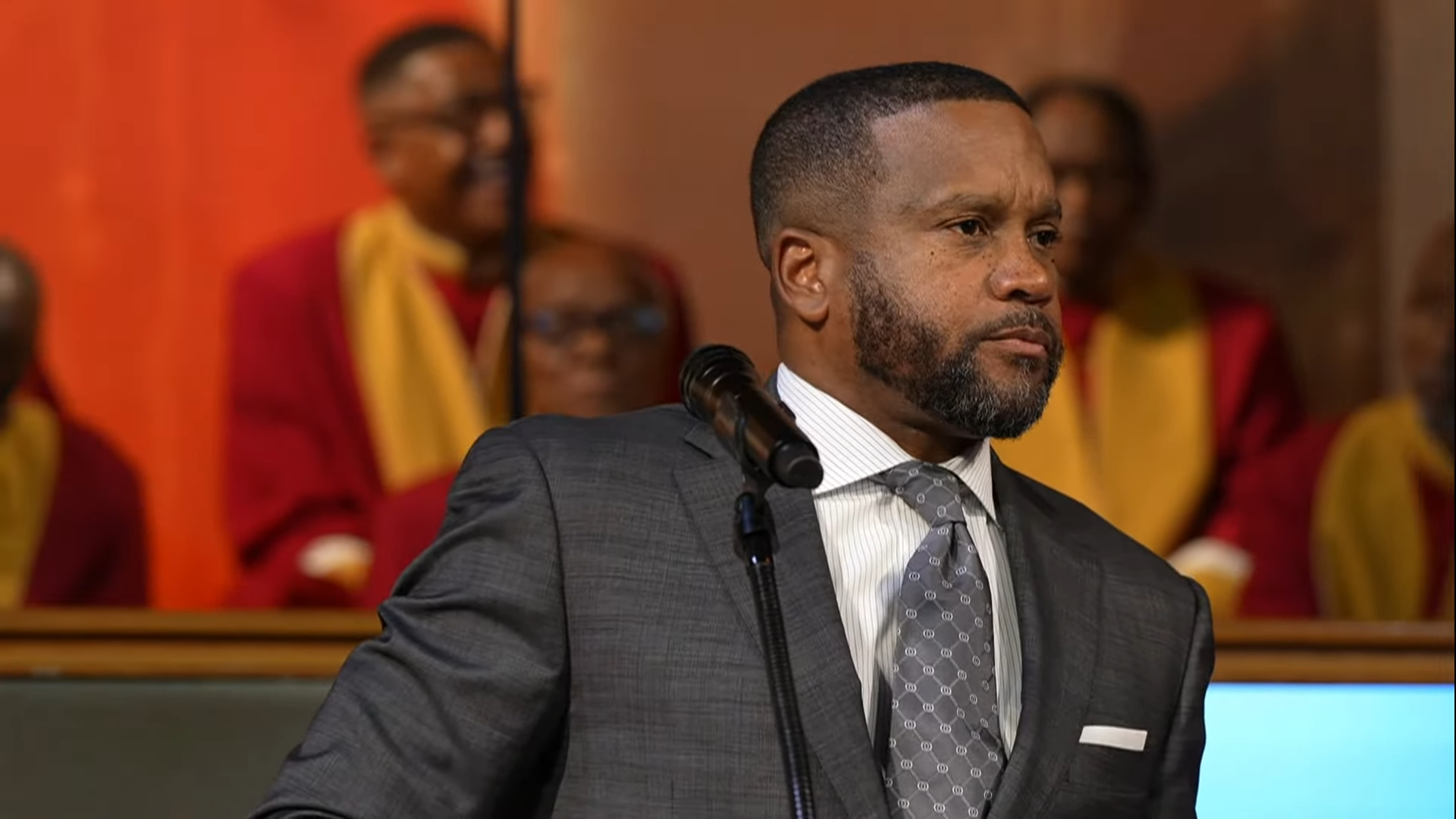
Rev. Dr. Howard-John Wesley’s Bold Message on Social Justice and Double Standards
Rev. Dr. Howard-John Wesley, the revered senior pastor of Alfred Street Baptist Church in Alexandria, Virginia, took center stage this past Sunday with a powerful sermon that reverberated deeply within the community. His words captured the complexity of contemporary issues, weaving together themes of morality, racial justice, and the troubling polarization of American society.
Context: The Aftermath of Charlie Kirk’s Assassination
At the core of Rev. Wesley’s recent message was the tragic assassination of Charlie Kirk, a prominent right-wing commentator, who lost his life at Utah Valley University on September 10. Despite Kirk’s divisive rhetoric, his death has prompted an outpouring of tributes from conservative circles, elevating him to an almost martyr-like status. Flags were ordered to half-mast by President Donald Trump, and Vice President J.D. Vance accompanied his body home via Air Force 2, signifying state-sanctioned mourning for a man who many believe perpetuated hostility and division.
A Call for Critical Reflection
Living in the D.C. area, Rev. Wesley was powerfully struck by the sight of mourning flags. He used this imagery as a launchpad to question the societal norms surrounding grief and honor, especially when it comes to figures like Kirk. “I do not celebrate the killing of anyone,” he began, emphasizing that while he condemned the act of violence against Kirk, he felt compelled to highlight the discrepancies in how different lives are valued in America.
His stark juxtaposition of outrage for Kirk contrasted sharply with the quiet grief that followed other tragic events, particularly the shootings of innocent lives like Melissa Hortman and her husband, who seemed to fade from the public consciousness. This inconsistency, he argued, points to a deeper cultural hypocrisy.
The Flaws in Compassion for Divisive Figures
Rev. Wesley’s sermon escalated as he addressed the calls for compassion that often surround public figures, regardless of their impact on marginalized communities. His heartfelt declarations highlighted his struggle with a societal expectation to grieve for someone whose actions sowed division and racism. “Do not tell me I ought to have compassion for the death of a man who had no respect for my own life!” he implored, igniting a wave of applause from the congregation.
He firmly stated that while some may view Kirk through a lens of heroism due to his untimely death, such narratives do not override the harm he perpetuated throughout his life. “How you die does not redeem how you lived,” Rev. Wesley asserted, a poignant reminder of the moral complexities interwoven into discussions of life, value, and legacy.
A Personal and Collective Overwhelm
As Rev. Wesley continued, the emotional weight of his message became palpable. His candid admissions of feeling “overwhelmed” captured the emotional and spiritual toll that systemic injustices impose on individuals, particularly in marginalized communities. He lamented the pervasive atmosphere of division, pointing to ICE raids, white supremacy rallies, and the erosion of fundamental liberties as manifestations of a culture slipping into intolerance and division.
His reflections on the prioritization of resources—where funding for immigration enforcement overwhelms support for healthcare—further emphasized the systemic inequities that fuel societal discord. “I am overwhelmed listening to those who think they have this singular right to define and determine who belongs in America,” he lamented, invoking the historical contributions of Black Americans who helped build the nation.
The Christian Conundrum
Rev. Wesley extended his critique beyond politics to encompass the spiritual landscape, highlighting a disconnect within self-identified Christians. He warned against a superficial religiosity that fails to enact real change or embody the love taught by Jesus. “I’m overwhelmed by folk who call themselves Christian, but never loved like Jesus,” he stated, reflecting deep dissatisfaction with a narrative that allows individuals to claim faith while fostering division and hatred.
His words resonated with many in the congregation who share a similar frustration. The pastor’s passionate address served as a rallying cry for introspection and a call to live out the tenets of compassion and love in both personal and communal practices.
Community Response and Engagement
Rev. Wesley’s thought-provoking sermon not only engaged his congregation but also sparked wider dialogues on social media and community discussions in Alexandria and beyond. The stark realities he articulated challenge attendees to reflect on their own values and beliefs while prompting a reexamination of how society honors life and death.
In a time where division often threatens to overshadow unity, Rev. Wesley’s message stands as a poignant reminder of the work that remains in pursuit of a truly equitable society. It calls for an active engagement in conversations about justice, equity, and the moral imperatives that guide faith and civic responsibilities alike.