


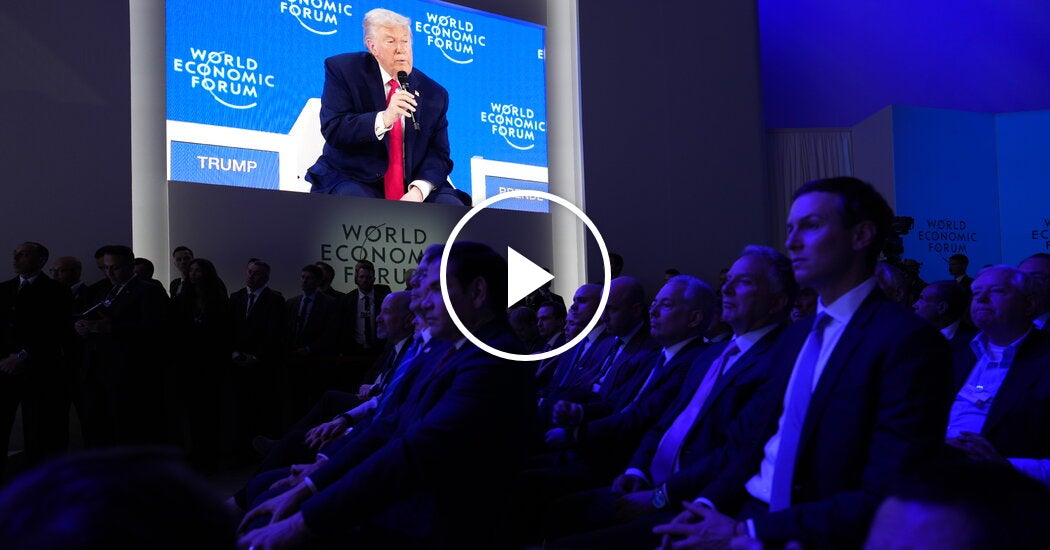
Trump Targets European Allies at Davos: A Closer Look
In a striking appearance at the World Economic Forum in Switzerland, President Donald Trump delivered a lengthy speech that not only reinforced his controversial aspirations regarding Greenland but also criticized European allies in a manner that has drawn significant attention. His remarks, filled with bold assertions, paint a vivid picture of his administration’s foreign policy stance and its implications for relations between the United States and Europe.
The Claim Over Greenland
One of the most eye-catching proclamations from Trump’s speech was his renewed ambition to acquire Greenland. Despite the initial backlash when this idea first surfaced, Trump reiterated his desire, albeit insisting that he wouldn’t resort to military means to achieve it. “All the United States is asking for is a place called Greenland,” he stated, igniting conversations about geopolitical strategy and the significance of this Arctic territory. Trump framed the acquisition as a mutually beneficial arrangement but alluded to perceived inadequacies in the current relationship with Greenland.
Critique of European Allies
Beyond Greenland, Trump’s comments extended to critique European allies, reflecting a broader sentiment about America’s role on the global stage. He emphasized his belief that many European nations are not truly supportive of U.S. interests. This perspective is rooted in his claims that, “Without us, most of the countries don’t even work.” This dramatic assertion hints at a transactional view of international relations, where Trump positions the U.S. as the indispensable partner for economic and political stability in Europe.
The Reference to Iceland
Trump’s remarks included a notable reference to Iceland, which he claimed had adversely affected U.S. financial markets. “Our stock market took the first dip yesterday because of Iceland,” he commented, suggesting that the small island nation had far-reaching consequences on U.S. economic health. This assertion has raised eyebrows and sparked debate about whether Trump fully grasps the complex interdependencies that define global markets.
Calls for Cooperation
Interestingly, the former president maintained that he values Europe and desires its success. “I love Europe, and I want to see Europe go good,” he stated, juxtaposing his admiration for the continent with his dissatisfaction over current cooperative efforts. Trump expressed a desire for European nations to “come together and get a deal done,” emphasizing a sense of urgency that he perceives among allies. He highlighted the need for a collaborative approach, urging leaders to act swiftly and intelligently for mutual benefit.
The Underlying Strategy
Trump’s rhetoric at Davos can be interpreted as part of a larger strategy aimed at reshaping U.S. foreign policy. By directly addressing perceived imbalances in alliances and underlining economic dependencies, he aims to assert American strength while pushing for a reshuffling of global power dynamics. This speech may signal a move toward more aggressive diplomatic negotiations, centered on America’s interests and its economic leverage.
Public Reactions and Implications
The tone and content of Trump’s speech have sparked a variety of public reactions, from support among his base to criticism from political commentators and European leaders. Many are left wondering how such a discourse will affect long-standing alliances that have defined transatlantic relations. The ramifications of his statements could influence international negotiations and reshape the diplomatic landscape, prompting European nations to reassess their partnerships with the United States in light of Trump’s bold claims.
Conclusion
As the world absorbs the implications of Trump’s latest statements, it becomes evident that his approach to foreign policy, especially concerning Europe, is characterized by a mix of bravado and strategic calculation. His insistence on promoting the interests of the United States while addressing allies offers a complex narrative of modern diplomacy, one that diverges sharply from traditional forms of engagement. The speech resonates as both a declaration of intent and a challenge to the status quo, leaving observers keen to see how these tensions will unfold in the coming months.