


Trump’s Economy: A Closer Look at Claims and Realities
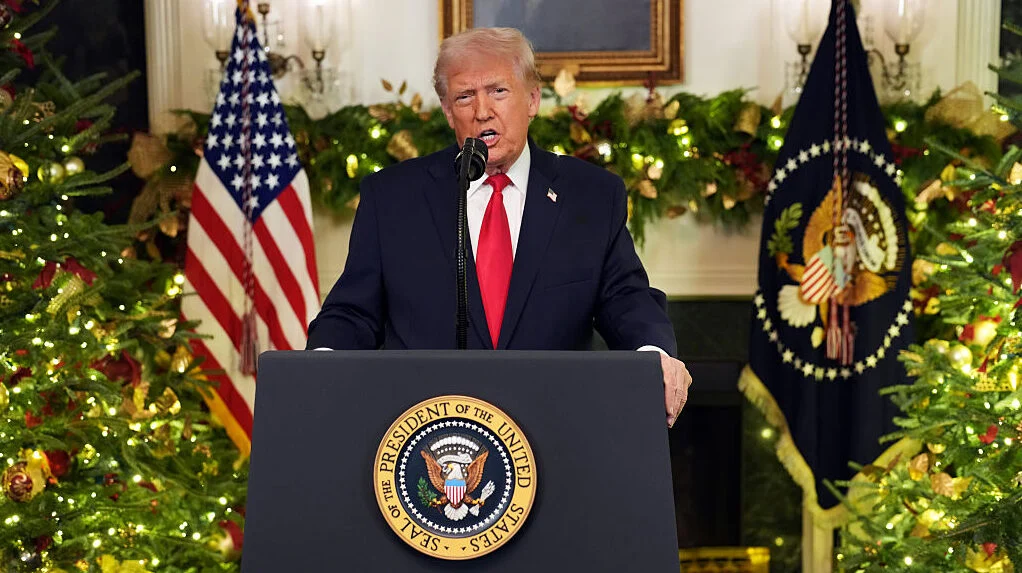
In a recent address from the White House, President Donald Trump sought to project a positive outlook on the economy, emphasizing his efforts to improve a situation he characterized as dire. “Eleven months ago, I inherited a mess, and I’m fixing it,” he asserted, placing the blame squarely on the Biden Administration for rising costs.
Economic Claims and Counterarguments
Trump’s speech included a flurry of statements aimed at highlighting his economic policies. He asserted, “The last administration and their allies in Congress looted our Treasury for trillions of dollars, driving up prices at levels never seen before.” He expressed confidence in his ability to manage the economy better than his predecessor, pledging, “I am bringing those high prices down—very fast.” However, for many Americans, especially Black and young voters who bolstered his coalition in the 2024 presidential election, this narrative clashes with their daily realities.
Exaggerated Statistics
While Trump cited declining prices for various goods, such as eggs, he significantly overstated decreases in gas prices. His claim that “wages are going up much faster than inflation” also sparked skepticism. In actuality, data from the U.S. Department of Labor Statistics indicates that inflation has remained consistent, precisely where it was when Trump took office in January.
Employment Trends and Discrepancies
One of the most critical economic indicators is the unemployment rate. Currently, the U.S. unemployment rate stands at 4.6%, which is notably high since the pandemic’s peak in 2021. Even more alarming, the unemployment rates among Black Americans (8.3%) and young people (10.6%) are significantly worse. Historically, when Trump took office, Black unemployment was just above 6%, during a period that many viewed as nearing historic lows. However, it has since risen, drawing concerns from various quarters about the efficacy of Trump’s economic strategies.
Angela Hanks, a former Biden Labor Department official, articulated this concern: “In just under a year, his chaotic economic policies have driven [Black unemployment] up to 8.3%, the highest level since August 2021.” These remarks underscore the growing unease over job security for Black Americans under Trump’s economic reign.
Trade Policies and Their Impact
Within his first term, Trump introduced a series of uneven tariffs on foreign trade, which many economists argue have contributed to increased costs for consumers. The fallout from these policies has been palpable, with numerous businesses responding by laying off workers in an effort to manage expenses. Hanks further noted that Black workers tend to face increased challenges in the labor market, exacerbated by discrimination, a sentiment echoed by many policy analysts.
As the Trump Administration’s policies have unfolded, the Black unemployment rate, which had celebrated a historic low of 4.8% in April 2023 under former President Joe Biden, now stands in stark contrast to its earlier achievements. Derrick Johnson, President of the NAACP, encapsulated the sentiments of many critics when he stated, “If we had to give Donald Trump’s economy a grade, it would be an F. Fail fail fail fail fail.”
A Looming Healthcare Crisis
In addition to escalating unemployment rates, Americans are bracing for a projected rise in health care premiums, which could further strain household budgets. Public polling indicates that Trump may be losing favor with voters, particularly in terms of his economic policies. According to a recent NPR/PBS News/Marist poll, only 36% of Americans approve of Trump’s management of the economy.
Immigration and Labor Market Effects
During his campaigning in the 2024 election, Trump made headlines with statements about undocumented immigrants allegedly taking “Black jobs.” Despite harsh immigration policies aimed at mass arrests and deportations, a report by the Center for American Progress cautioned that Trump’s policies disproportionately harm the Black middle class.
As the report articulated, “the Trump Administration’s so-called ‘golden age’ is only for the billionaires he’s enriching by gutting social programs.” This critique highlights the significant gulf between the rhetoric surrounding economic improvement and the tangible experiences of everyday Americans.
The Disconnect: Policy vs. Reality
In exploring Trump’s economic agenda, one finds a complex interplay between proclamations of success and the lived experiences of Americans facing rising living costs, unemployment, and predictions of healthcare challenges. The divide is especially evident among Black Americans, who many hoped would benefit from stable economic conditions but are instead grappling with uncertainties exacerbated by current policies.
This examination of Trump’s economic claims and the on-the-ground realities suggests an intriguing yet troubling picture, resonating with concerns shared across demographic lines. The contrast between political rhetoric and the intricate dynamics of the economy continues to fuel discussions about its true impact on diverse communities throughout the nation.