


The Proposed Paris-Style Arch: A Controversial Tribute to Trump
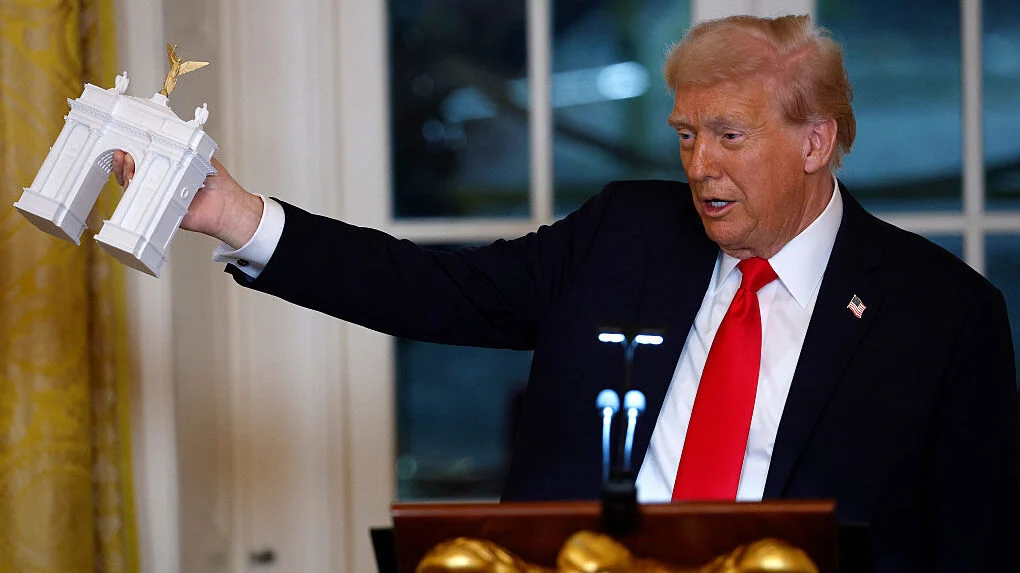
In a bold move that has stirred both interest and debate, President Donald Trump recently previewed plans for a proposed arch in Washington, D.C., inspired by the iconic Arc de Triomphe in Paris. This project is anticipated for the United States’ 250th anniversary and is touted by Trump as a tribute to his presidency. The arch, informally referred to as the “Arch of Trump,” has garnered mixed reactions, particularly given its historical context.
The Vision: A Modern Monument
During a press opportunity in the Oval Office, President Trump shared his vision for the arch, claiming, “It’s going to be beautiful.” The architectural design aims to echo the grandeur of both the Arc de Triomphe and the Soldiers and Sailors Memorial Arch in Brooklyn, New York. Both existing structures commemorate sacrifices made during significant historical events—the French Revolution and the U.S. Civil War, respectively. Trump’s intent, however, represents a departure from these traditional tributes, as he aims to commemorate his own legacy.
In a dinner with donors who are contributing to a separate $200 million ballroom project on White House grounds, Trump presented prototypes of the arch, explaining that it would be located near the Arlington Memorial Bridge—between Arlington Cemetery and the Lincoln Memorial. He noted that many who pass over the bridge feel that “something is supposed to be here.”
Echoes of History: Robert E. Lee’s Shadow
What adds another layer of complexity to Trump’s proposal is his reference to Confederate General Robert E. Lee during the unveiling. In his comments, Trump recounted that a statue of Lee had once been considered for the same location where the arch may now rise. “It would have been OK with me—would’ve been OK with a lot of the people in this room,” he stated, referencing the arch’s historical context and the symbolism associated with Lee.
Robert E. Lee was a prominent figure during the Civil War, serving as the general of the Confederate Army, which fought to maintain slavery in the United States. He owned hundreds of enslaved individuals and is a highly polarizing figure in American history. The mention of Lee not only raises eyebrows but also raises questions about the implications of building a monument in Washington, D.C., that invokes his legacy.
The Controversy Around Confederate Symbols
Trump’s affinity for Confederate symbols has long been a contentious topic. He has been known to support monuments that honor the Confederacy and has criticized efforts to remove them. As pointed out by Cassandra Douglass from the Southern Poverty Law Center (SPLC), statues of Confederate leaders have historically served to assert dominance over marginalized communities and perpetuate a narrative supporting racial oppression.
SPLC’s research highlights that over 2,000 Confederate symbols exist throughout the U.S., often positioned in areas with histories of racial violence. This context raises the stakes concerning Trump’s proposed arch: will it contribute to the glorification of a legacy steeped in societal division?
Implications for Military Namesakes
Beyond monuments, Trump’s stance on Confederate symbols extends to military bases named after Confederate leaders. Following his return to the White House, he has expressed intentions to rename several military installations back to their original names, which were altered to remove associations with the Confederacy. This has sparked heated discussions around the appropriateness of venerating figures who fought to uphold slavery.
In statements dismissing the removal of such symbols as overly “woke,” Trump’s position resonates with some supporters who feel these acts are an affront to American heritage. However, many argue that preserving Confederate imagery does not honor history; rather, it perpetuates a painful legacy.
A Polarizing Legacy
As Trump continues to advocate for the proposed arch, the juxtaposition of his vision against the backdrop of a nation grappling with its history creates a complex narrative. The choice to honor his presidency while referencing a divisive figure like Lee invites scrutiny and debate over the broader implications of his administration’s approach to memorialization and historical context.
The arch, whether realized or not, is likely to symbolize more than a mere structure; it encapsulates ongoing national dialogues about identity, memory, and the legacies we choose to elevate in the public sphere. With its potential construction set against the backdrop of America’s 250th anniversary, the arch represents both hope for unity and the challenges of reconciling a fragmented past.