


Unpacking the Weight of Monuments: From Wilmington, NC, to the Heart of Los Angeles
In the quaint town of Denton, North Carolina, where the population hovers around 1,600, a troubling trend emerges as Confederate monuments removed from coastal Wilmington—just over three hours away—find a new home at the private Valor Memorial Park. One monument, dedicated in 1911, honored a local railroad attorney who became the last Confederate attorney general, while another, erected in 1924, commemorates soldiers from the Confederate era. Both memorials were sponsored by the United Daughters of the Confederacy, reinforcing a narrative of historical valor intertwined with the racist ideology of the Jim Crow era.
The History Behind the Stone
These statues represent more than mere stone; they are embodiments of the “Lost Cause” mythology—a revisionist narrative framing the Civil War as a noble fight rather than a brutal conflict rooted in the preservation of slavery. Valor Memorial Park, with its twisted representations of history, stands as a disturbing monument to the moral decay of these bygone beliefs. This phenomenon has gained renewed scrutiny with the introduction of a crucial exhibition at the Museum of Contemporary Art in Los Angeles.
A Timely Exhibition: “MONUMENTS” at MOCA
Titled simply “MONUMENTS,” the exhibition screams urgency and critical reflection through its all-cap presentation. It confronts the uncomfortable resurgence of white supremacy, a movement that has gained momentum over the past decade, often cloaked in the garb of Christian nationalism. The exhibition weaves together cautionary art history and poignant responses from 20 artists, emphasizing the continued struggle against these insidious ideologies.
In sharp contrast to the sidelined narratives promoted by traditional monuments, “MONUMENTS” serves as both a critique and a reimagining of memorialization, offering a platform for dialogue rather than glorification. Co-organized by the Museum of Contemporary Art and a small nonprofit called The Brick, this exhibition has been eight years in the making—an effort that feels ever more pressing in light of recent societal upheavals.
Historical Context: A Response to Violence
The urgency of this exhibition can be traced back to significant flashpoints of racial violence in America. The 2015 massacre of nine Black parishioners at Mother Emanuel A.M.E. Church in Charleston, South Carolina, reverberated throughout the nation, solidifying the urgency for reflection and change. Similarly, the rise of white nationalist rhetoric in public discourse, exemplified during the Charlottesville rally in 2017 and the storming of the Capitol on January 6, has prompted a reevaluation of how society engages with commemorative public art.
In the wake of George Floyd’s murder in 2020, calls to dismantle Confederate monuments intensified, reflecting a broader demand for accountability and systemic change. The exhibition at MOCA encapsulates this yearning for a dialogue about race, power, and the narratives we choose to celebrate publicly.
Artistic Engagement: The Form and Function of Memory
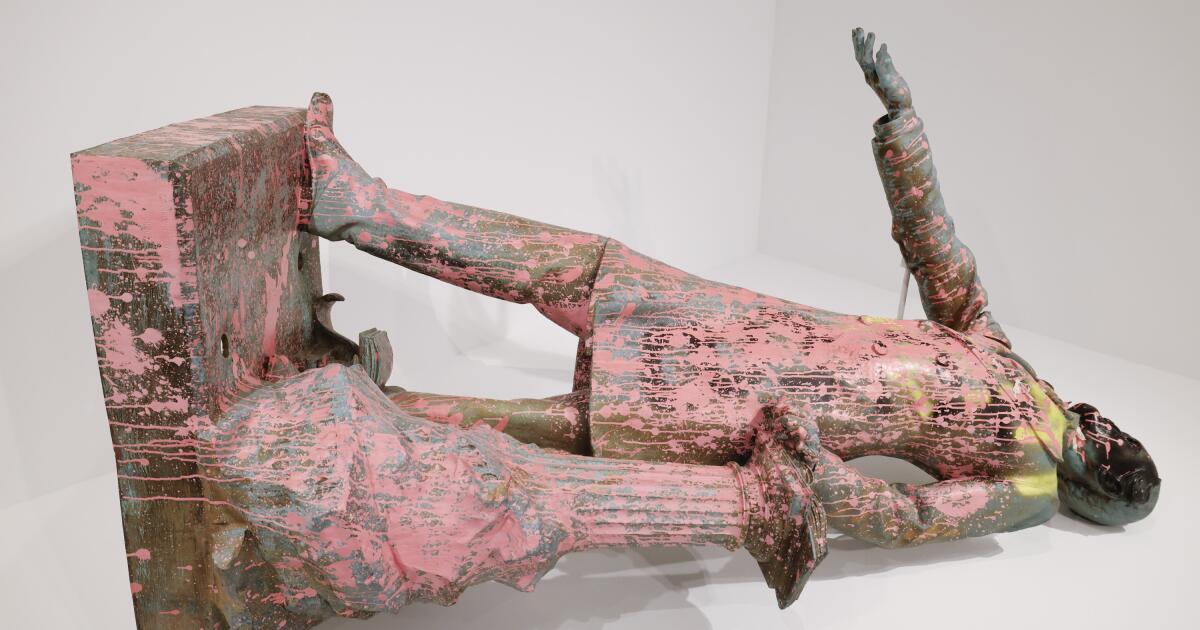
Inside MOCA’s Geffen Contemporary, the display presents a duality: actual Confederate memorials juxtaposed with responses from contemporary artists. Visitors are invited to confront the physicality of these monuments, often perched high on pedestals and seen only from afar. By lowering these monuments to eye level, the exhibition abolishes their elevated status and demands a reconsideration of their role in public memory.
For instance, artist Cauleen Smith’s project pulls back the veil on the surveillance aspect of these statues. Through video, she presents the outstretched arm of a figure from a long-gone era, broadcasting a pointed finger aimed at the heavens—a reminder of the oppressive gaze these monuments signify.
Symbolic Undertones of Religious Appropriation
The exhibition also delves into the intertwining of white supremacy and religious symbolism. A particularly disturbing representation is a 1917 monument that depicts a soldier draped in a battle flag, cradled by a woman echoing a pietà—a scene that taints the sanctity of Christian imagery, co-opting it for a narrative of division and hatred.
The profound weight of this religious appropriation is further highlighted through the work of Jon Henry, whose photographs capture Black mothers in poses that mirror sacrificial depictions, juxtaposing collective grief with racial violence across America.
Revolutionary Transformations: The Art of Resistance
Engagement with the past takes on new dimensions as the exhibition features dismantled remnants of monuments, reflecting a transformation of symbols of oppression into artifacts that foster a new dialogue. One compelling piece showcases a defunct statue of Robert E. Lee, which has been repurposed into a statement about economic injustices tied to slavery.
Kara Walker’s artwork similarly dismantles traditional narratives, turning a historical equestrian sculpture into a grotesque figure devoid of a head—evoking the spectral remnants of white supremacy that continue to haunt the present day.
Legacy in the Making: A Contemporary Context
The exhibition shines a spotlight on lingering issues surrounding historical narratives and their legacy in today’s societal climate. While more than 200 Confederate monuments have been removed in recent years, a significantly larger number still remain, often fortified by entrenched systems of power that harness these images for political gain. Valor Memorial Park, in its grotesque homage to these statues, underscores the ongoing battle against the resurfacing tides of white supremacy.
The urgency to address and dismantle these lingering symbols of hate has never been more pressing—a sentiment echoed by the growing number of demonstrators advocating for racial equality and justice across the United States. The urgency encapsulated in “MONUMENTS” speaks not only to the past but also to the collective need for truth and reconciliation as we navigate the enduring legacies of these fragile histories.
As the exhibit continues through May 2026, its call to action resonates loudly: It’s time to confront the monuments of yesterday to create a more equitable future.
Practical Information
- Exhibition Title: MONUMENTS
- Location: Geffen at MOCA, Little Tokyo, Los Angeles
- Duration: Ongoing until May 3, 2026
- Admission: $10–$18; The Brick: Free
- Contact: MOCA Geffen 213-626-6222 | The Brick 323-848-4140
The time is now. The discourse around these monuments has shifted, and it’s essential to engage with the uncomfortable truths they represent. This exhibition promises to be a significant step toward understanding, healing, and ultimately redefining our collective memory.