


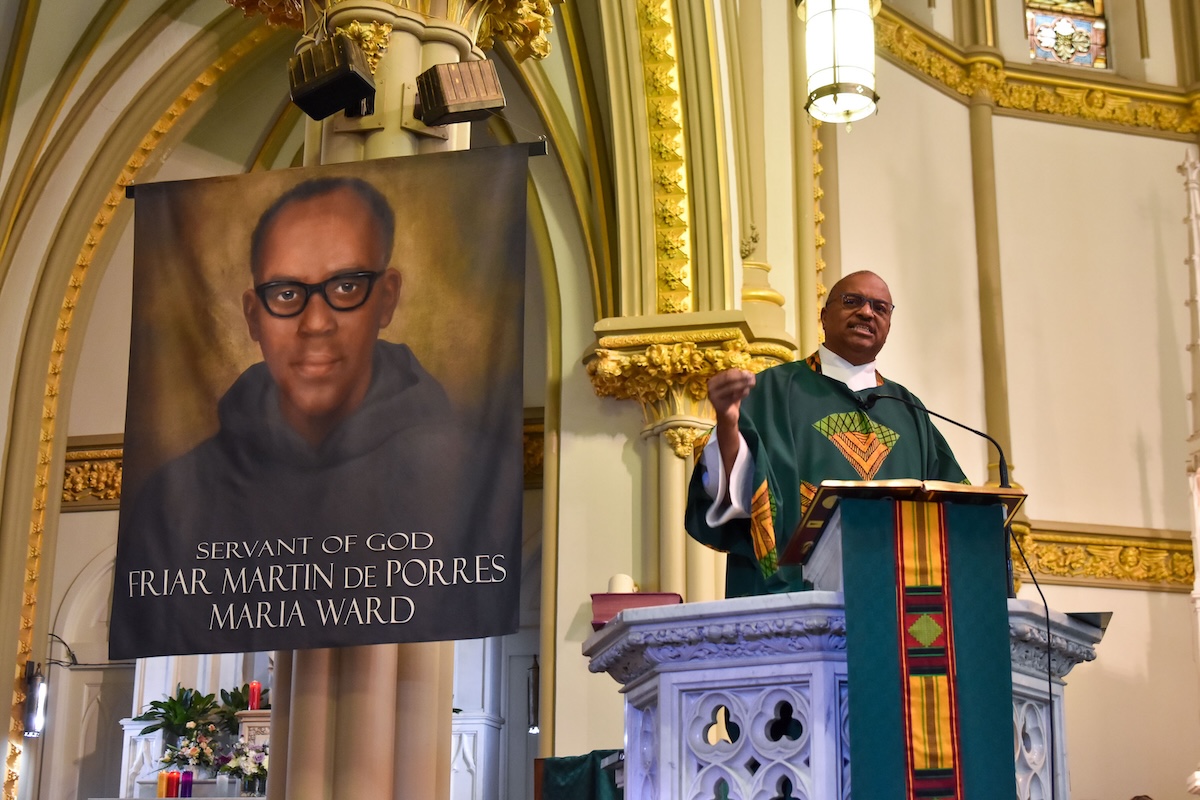
With the establishment of Black Catholic History Month in 1990, November has become a vital period for remembering the pivotal contributions of African American leaders whose narratives frequently vanish from mainstream American history. This observance provides an opportunity to spotlight individuals who have significantly influenced the Church and the wider society, yet are often overlooked in textbooks and public discourse.
Tracing its roots back to the 15th century, Black Catholics have played an essential role in shaping the fabric of the world. Their journey is marked by a dedicated mission of service and leadership that Father Patrick Smith, pastor of St. Augustine Catholic Church in Northwest D.C., emphasizes as critically significant as we approach 2025. “Especially in the society we see now, a renewed attack on Black American history … more than ever, people need heroes that look like them,” he states. “You can’t tell the story of Catholicism in the United States without telling the story of Black Catholics. We were there from the beginning.”
Thanks to the efforts of the National Black Catholic Clergy Caucus, which established Black Catholic History Month 35 years ago, the celebration continues to honor significant dates, such as Nov. 1 (All Saints Day), Nov. 2 (All Souls Day), and the Feast of St. Martin de Porres on Nov. 3. These occasions are intertwined with community legacies of resilience and leadership, serving as reminders of the rich tapestry of Black Catholic history.

Father Robert Boxie, the priest chaplain of Howard University, emphasizes the need for a year-round commitment to stewardship and activism. He argues that while November serves as a month of tribute, it should also inspire ongoing efforts to uplift the community. “We should take our marching orders every November … and it should inspire us to do the work that we are called to do: uplifting our community, taking care of those in need … [and] do that in a way that highlights the gifts of the Black community,” Boxie explained. He urges leaders to embody the joy and richness of Black culture in their actions as people of faith.
Catholic Leaders Tout Year-Round Mission, ‘Set the Record Straight’
The values encapsulated within the Sister Thea Bowman Catholic Student Center at Howard University are preserved throughout the year. Its ambiance is adorned with decor honoring ancestors and is a venue for masses and discussions featuring the influential namesake. Boxie underlines that recognizing African American Catholics does more than conserve histories; it lays down the groundwork for future leaders. “When we tell these stories, our students can identify with these holy men and women,” he emphasized, “and given that they can see themselves in them, that just opens up a whole door of possibility that had been unknown to them beforehand.”
As a member of the Archdiocese of Washington, Father Boxie celebrates the impactful leadership of several predecessors who have influenced American progress. Notable figures include Diane Nash, a pivotal player in the Civil Rights Movement, Father Augustus Tolton, recognized as the first Black priest in 1886, and Venerable Pierre Toussaint, a key figure in founding the charitable arm of the Archdiocese of New York.

Father Boxie also praised the late Sister Thea Bowman for her dedication to racial justice, which underscored the beauty of Black Catholicism. She co-founded the Institute for Black Catholic Studies at Xavier University of Louisiana, the sole historically Black Catholic institution in the country. “All of this reminds [us]… that we are here, we are present. We are part of this global church,” he said, emphasizing the importance of Black Catholics in the broader Church landscape.
His own connection to faith blends diasporic traditions with religious teachings, showcasing the richness of the Black Catholic experience. “It taps into all those aspects of … who I understand God to be … and who I am as a Black man,” Boxie expressed. He believes that it is crucial to present the gospel in a manner that resonates with young people, effectively addressing their needs while maintaining authenticity.
Father Smith, who grew up in a multi-generational Catholic family in D.C., experienced an epiphany regarding his vocation. Recognizing that his life’s direction was about fulfilling God’s plan rather than merely following his own desires has played a vital role in shaping his mission. He reflects, “The mission we have [today] is a mission Jesus gave the Apostles: ‘go and make disciples, teach them what I command you, baptize them, teach them as I commanded you.’” His perspective reinforces the idea that every individual has a significant purpose within the grand narrative of faith.
Smith recalls the resilient figures who contributed to the establishment of the Saint Augustine Catholic School in 1858 and the African Americans who were foundational in forming the nation’s first freed Black town, Gracia Real de Santa Teresa de Mose, known today as Fort Mose. For him, this legacy of freedom and justice thrives through generations of stewards who continue to “set the record straight” about their profound influence on American history.
Boxie highlights the modern leaders’ responsibility to empower young individuals who seek belonging and purpose, as well as the ongoing struggle for justice. He asserts that creating a better world is not confined to November; rather, it is a continuous, year-round commitment from Black Catholics in Washington. “We just have to do the work,” Boxie states. “All the things that we believe, we put that into action, and that makes a true, genuine, authentic witness of being a person of faith.”