


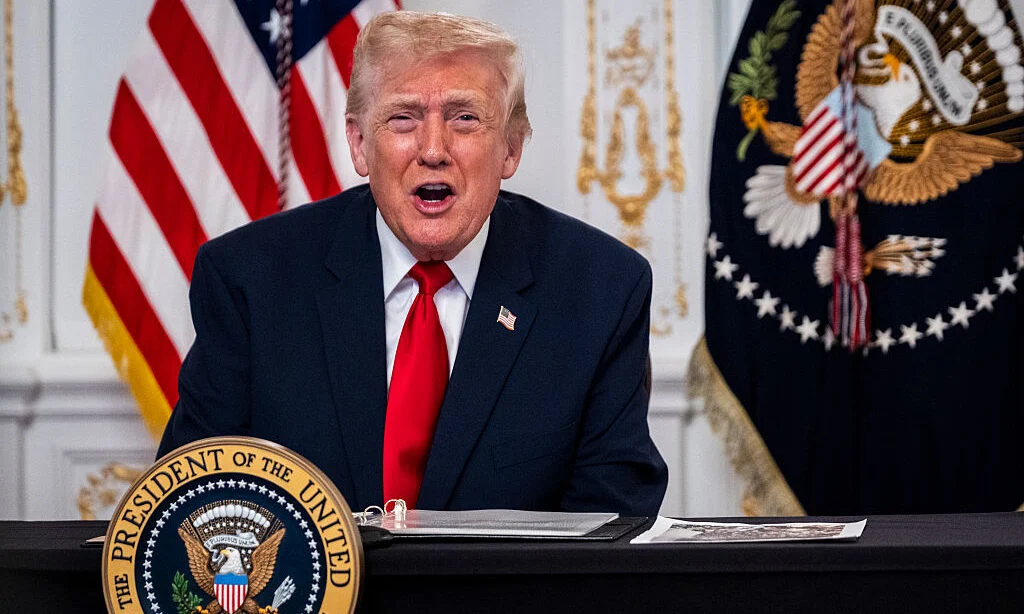
President Trump’s Anti-Immigration Stance: A Thanksgiving Message
On Thanksgiving, President Donald Trump used social media to deliver a sharp and controversial message regarding immigration, vowing to “permanently pause migration” from poorer nations. His statement followed the tragic shooting of two National Guard members in Washington, D.C., a situation that intensified his rhetoric against immigrants, particularly those from conflict-ridden countries.
Background of the Incident
The shooting, which involved a 29-year-old Afghan national, is linked to a program designed to resettle individuals who assisted American troops in Afghanistan. This incident reverberated through the political landscape, as it occurred just before Trump addressed U.S. troops via video on Thanksgiving Day. Notably, one of the guards, Specialist Sarah Beckstrom, succumbed to her injuries, adding a somber context to Trump’s remarks.
Trump’s Messaging on Truth Social
In his lengthy post on Truth Social, Trump stated that “only REVERSE MIGRATION can fully cure this situation,” which reflects a drastic policy stance aimed at limiting immigration. The implications of such measures would likely send shockwaves across a nation that prides itself on being a melting pot of cultures and opportunities. His message was laced with disdain for those he claims devalue American society, as illustrated by his comment: “You won’t be here for long!” directed at individuals he perceives as negative influences in the U.S.
The Economic Impact of Immigration Policies
Historically, the United States has been reliant on the contributions of foreign-born workers, who account for nearly 31 million jobs. Trump’s proposed policies of increasing deportations could have significant economic repercussions. Communities that depend on immigrant labor, from construction sites to schools, might face severe disruptions under stricter immigration controls.
Misconceptions About Crime and Immigration
Central to Trump’s narrative is the belief that immigrants contribute to crime, a notion that documents and studies frequently contest. A review published in the Annual Review of Criminology found that increased concentrations of immigrants in neighborhoods do not relate to higher crime rates. In fact, a 2023 study highlighted that immigrants are 60% less likely to be incarcerated than their U.S.-born counterparts, underscoring a long-standing trend that counters Trump’s claims.
Childhood and Cultural Assertions
Trump’s assertions extend into cultural territory, claiming that immigrants from certain countries, notably Somalia, are “completely taking over” states like Minnesota. His derogatory language, including outdated slurs, aimed at state governors complicates an already heated political dialogue and illustrates a divisive approach to cultural identity in America.
Increased Scrutiny on Immigrants
Following the shooting incident, Trump called for a deeper investigation of all Afghan refugees admitted during President Biden’s administration. The urgency to screen individuals from 19 “high-risk” countries has also been reiterated by officials within U.S. Citizenship and Immigration Services, suggesting an escalating focus on national security intertwined with immigration policy.
Reactions and Broader Implications
The shooting event seems to have triggered a broader critique from Trump regarding Afghan immigrants, though he was careful to distance himself from blaming all Afghans for the act of one individual. His comments reflect a long-standing tension around the integration of refugees and immigrants into American society, emphasizing how singular events can shift the narrative and influence national discourse.
The dynamics at play illustrate not just a moment of political posturing but a fundamental re-examination of America’s identity as a nation built on immigration. The consequences of such sentiments extend beyond rhetoric, impacting policy, community relations, and the lives of millions who see the U.S. as a land of opportunity.