


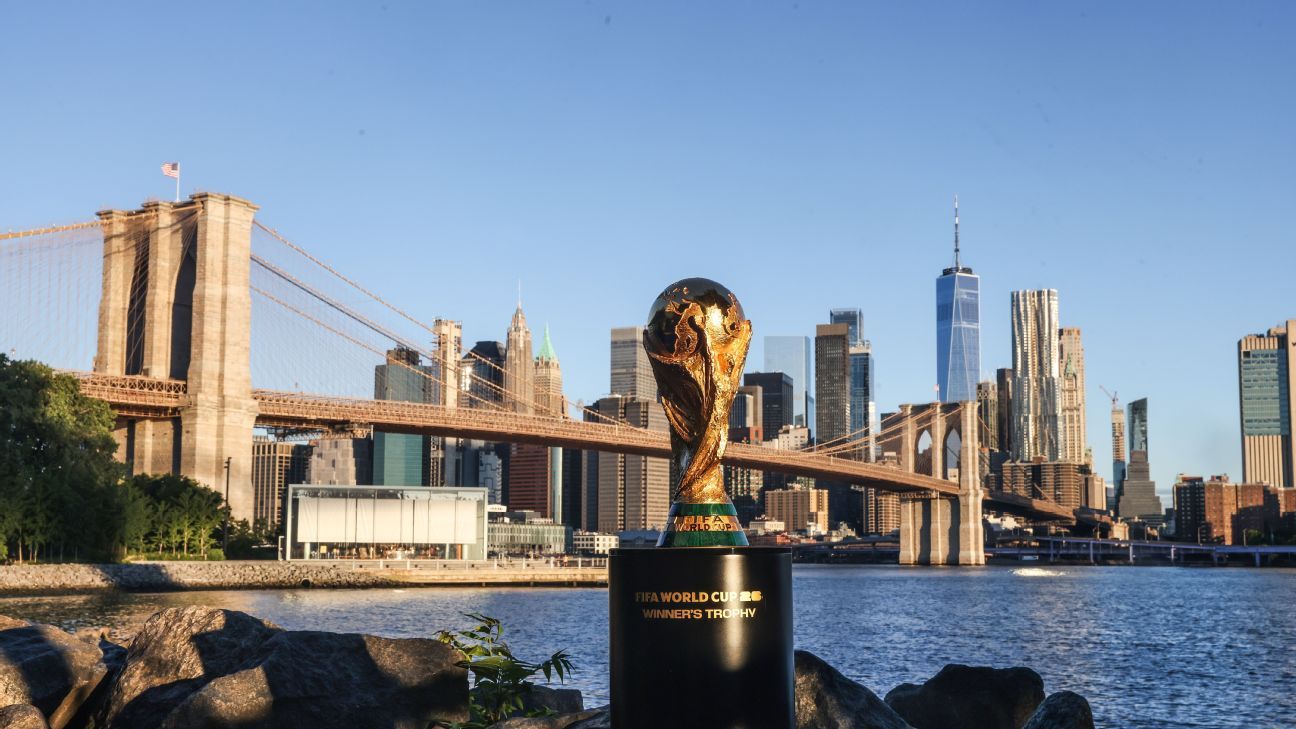
The stage is almost set for the 2026 World Cup, which begins June 11 and concludes with the final on July 19. Here’s what you need to know about the draw and the tournament as a whole.
When is the World Cup draw?
The draw ceremony is set to take place at noon ET (5 p.m. GMT) on December 5 at the iconic Kennedy Center in Washington, D.C. This event marks a significant milestone as teams and fans eagerly anticipate the group stage matchups that will shape the competition.
– O’Hanlon: All 64 national teams that can still win the 2026 World Cup, ranked
Who has qualified for the World Cup?
As of now, 42 of the 48 qualifying teams have been confirmed. The excitement doesn’t end there; you can check out who’s in and who’s still in the running as we gear up for the playoffs.
Why are the identities of six teams still unknown?
Six teams will secure their spots through the UEFA and interconfederation playoffs scheduled for March. Until then, we won’t know the final participants. Pot 4 will include placeholders for these playoff qualifiers, a familiar setup in previous World Cups.
Details on the playoffs can be found below.
– Ogden: Reacting to the 2026 World Cup playoff draw: Who will fill the final six spots?
How does the draw seeding work?
The draw will see the 48 teams—or placeholders—divided into four pots of 12 teams, based on FIFA’s World Rankings published on November 19. Each group will consist of one team from every pot. The host nations—the United States, Canada, and Mexico—will automatically be placed in Pot 1, having already been assigned specific groups. The top nine ranked countries will join the three hosts in Pot 1, with subsequent pots filled by the next highest-ranked teams.
It’s important to note that teams from the same pot cannot face each other in the group stage, ensuring a balanced distribution of talent across all groups.
How will the draw work?
The draw will kick off with Pot 1, where the host teams have already been allocated to their respective groups. For example, Mexico will play the tournament opener on June 11 at the Estadio Azteca in Mexico City. After the hosts are placed, the remaining teams from Pot 1 will be assigned to groups in alphabetical order, continuing this process through Pots 2, 3, and 4. FIFA estimates that the entire draw will last about 45 minutes within a one-and-a-half-hour show.
Are there any special conditions for the draw?
Indeed, for the first time in World Cup history, the four highest-seeded nations will be unable to meet until the semifinals, provided they all progress beyond the group stage. Spain (the No. 1 seed) and Argentina (No. 2) will be yanked to opposite paths to the semis, as will France (No. 3) and England (No. 4). This strategic adjustment by FIFA aims to promote an even distribution of top-tier squads throughout the tournament.
Furthermore, teams from the same confederation cannot be drawn into the same group, a rule that remains intact. However, since Europe has 16 representatives, groups will inevitably contain two UEFA teams. This constraint will also apply to the teams emerging from the interconfederation playoffs, which could further complicate the mix.
When will the full match schedule be finalized?
The comprehensive schedule, complete with each match’s venue and kickoff time, will be confirmed the following day at noon ET on December 6, immediately after the draw. Fans will have a clearer picture of what to expect from the tournament.
– World Cup 2026 qualifying: Who has qualified, and how the rest can make it
How will the remaining qualifiers be determined?
The pathways for the UEFA and interconfederation playoffs were defined on November 20, and here’s a brief look at what to expect:
Four paths were delineated for the UEFA playoffs, each featuring four teams competing for two semifinals, with the winners battling in the final for World Cup entry. These matches are slated for March 26 and 31.
UEFA PLAYOFFS
Path A: Italy vs. Northern Ireland, and Wales vs. Bosnia and Herzegovina; the winner of Wales-Bosnia will host the final.
Path B: Ukraine vs. Sweden, and Poland vs. Albania; the winner of Ukraine-Sweden will host the final.
Path C: Turkey vs. Romania, and Slovakia vs. Kosovo; the winner of Slovakia-Kosovo will host the final.
Path D: Denmark vs. North Macedonia, and Czechia vs. Republic of Ireland; the winner of Czechia-Republic of Ireland will host the final.
In contrast, the interconfederation playoffs will feature two paths for six teams. The highest-ranked FIFA teams—DR Congo and Iraq—are seeded directly into the final of their respective paths. The remaining four teams will battle it out in semifinals, with the winners moving to face the seeded teams. Jamaica and Suriname, both from Concacaf, cannot be drawn into the same path.
INTERCONFEDERATION PLAYOFFS
Path A: New Caledonia vs. Jamaica, with the winner advancing to face DR Congo.
Path B: Bolivia vs. Suriname, with the winner advancing to face Iraq.