


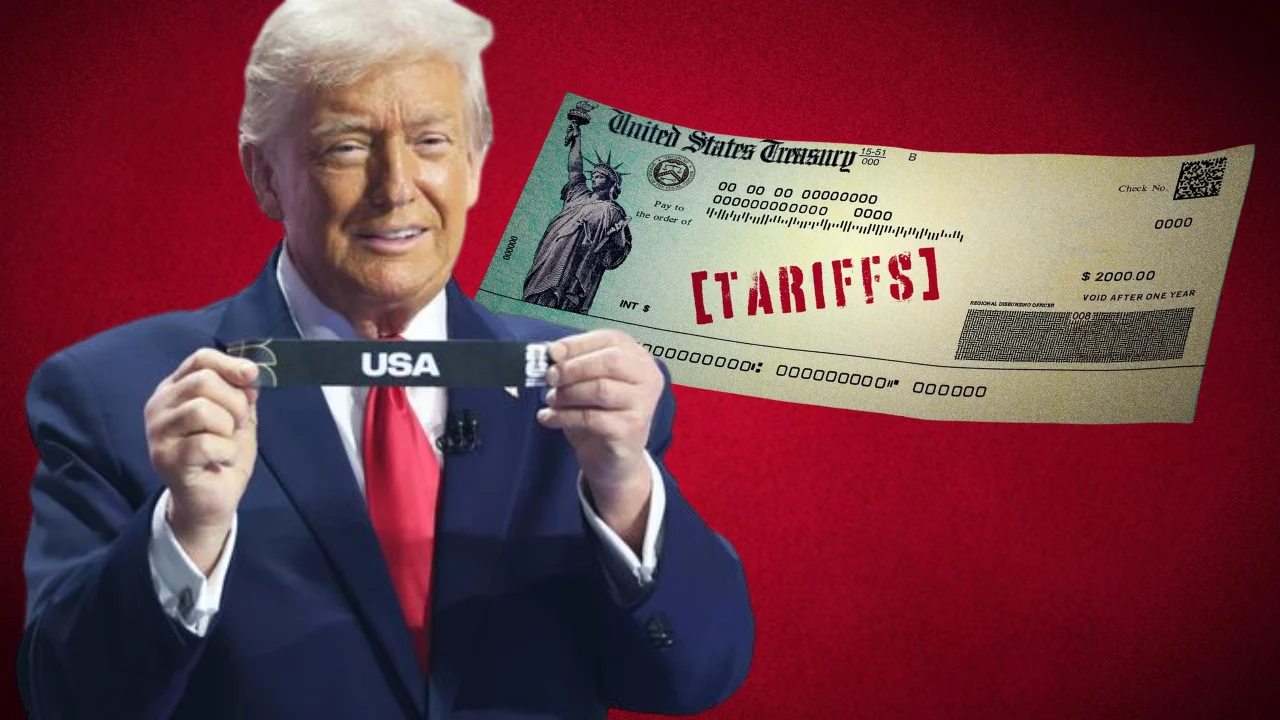
If you’ve been wondering whether a $2,000 “tariff dividend” check might hit your mailbox next year, you’re not alone. President Donald Trump isn’t backing off the idea and, in fact, is doubling down on this promise, even as the numbers behind it seem to grow murkier by the week.
During a recent Cabinet meeting, Trump channeled his signature boldness when discussing his plans for hefty rebate checks linked to U.S. tariff revenue. “Next year is projected to be the largest tax refund season ever,” he stated, making headlines with his assertion that the government would provide a “nice dividend” to citizens in addition to reducing national debt. Such remarks, punctuated by an unexpected moment where he appeared to nod off briefly, showcase his unwavering confidence in the financial benefits of his tariffs.
The concept of a $2,000 check isn’t new; Trump has been championing this idea since July. He posits that revenue generated from the tariffs he imposed in March and April could fund not only this “little rebate” but also a notable effort to diminish the national debt. In subsequent speeches, he intensified his rhetoric, suggesting that checks could be distributed “in the middle of next year,” promising “thousands of dollars” in relief for moderate- to middle-income families.
However, with growing promises come increasingly complex mathematical equations. The Congressional Budget Office recently slashed its projections for tariff revenue from an anticipated $3.3 trillion over the next decade to a significantly lower figure of $2.5 trillion. This downward revision signals a potential shortfall that could escalate government debt by approximately $500 billion—a concerning addition that could push the total financial implications to around $3 trillion.
Looking at even more conservative estimates, the *Committee for a Responsible Federal Budget* claims that tariffs might yield closer to $300 billion annually. They caution that the costs associated with distributing one round of dividend checks could soar to about $600 billion, arguing that tariff revenue should be used to alleviate the federal deficit rather than returning cash to taxpayers.
The Tax Foundation, a well-respected nonpartisan organization, also raises red flags. It anticipates Trump’s tariffs will contribute about $2.1 trillion in revenue over the next decade; however, this figure drops dramatically to $1.6 trillion when accounting for the economic backlash and retaliation from foreign nations. Experts from the foundation unanimously suggest that scrapping the tariffs altogether would provide a more effective strategy for financial relief than issuing checks.
Beyond the numbers, the legal foundation supporting these tariffs remains uncertain. On November 5, Supreme Court justices openly challenged the president’s authority to enforce such measures. If Trump intends to issue refunds, it’s clear he will require legislative backing, a point underscored by Treasury Secretary Scott Bessent in a recent media appearance.
As uncertainty looms over both the fiscal math and legal backing, Trump remains steadfast in his assertion that Americans deserve compensation. His acknowledgment that tariffs “may in some cases” raise prices reflects a shift from his earlier stance that these costs largely fell on foreign shoulders. The Tax Foundation projects that by 2025, these tariffs could effectively cost U.S. households an additional $1,100, escalating to $1,400 in 2026—a stark reminder of the potential financial burden on average citizens.
So, the question is: Will you actually receive a $2,000 tariff check? Given the unpredictable nature of tariff revenues and the obstacles that Trump’s proposal faces in becoming law, the likelihood appears tenuous. Until there’s clarity or alignment between financial projections and governmental actions, the expected “largest refund season in history” may remain firmly in the realm of speculation.
Presently, the only check Americans can count on is the one consistently written by the numbers—a script that doesn’t seem to align with the president’s optimistic forecast.