


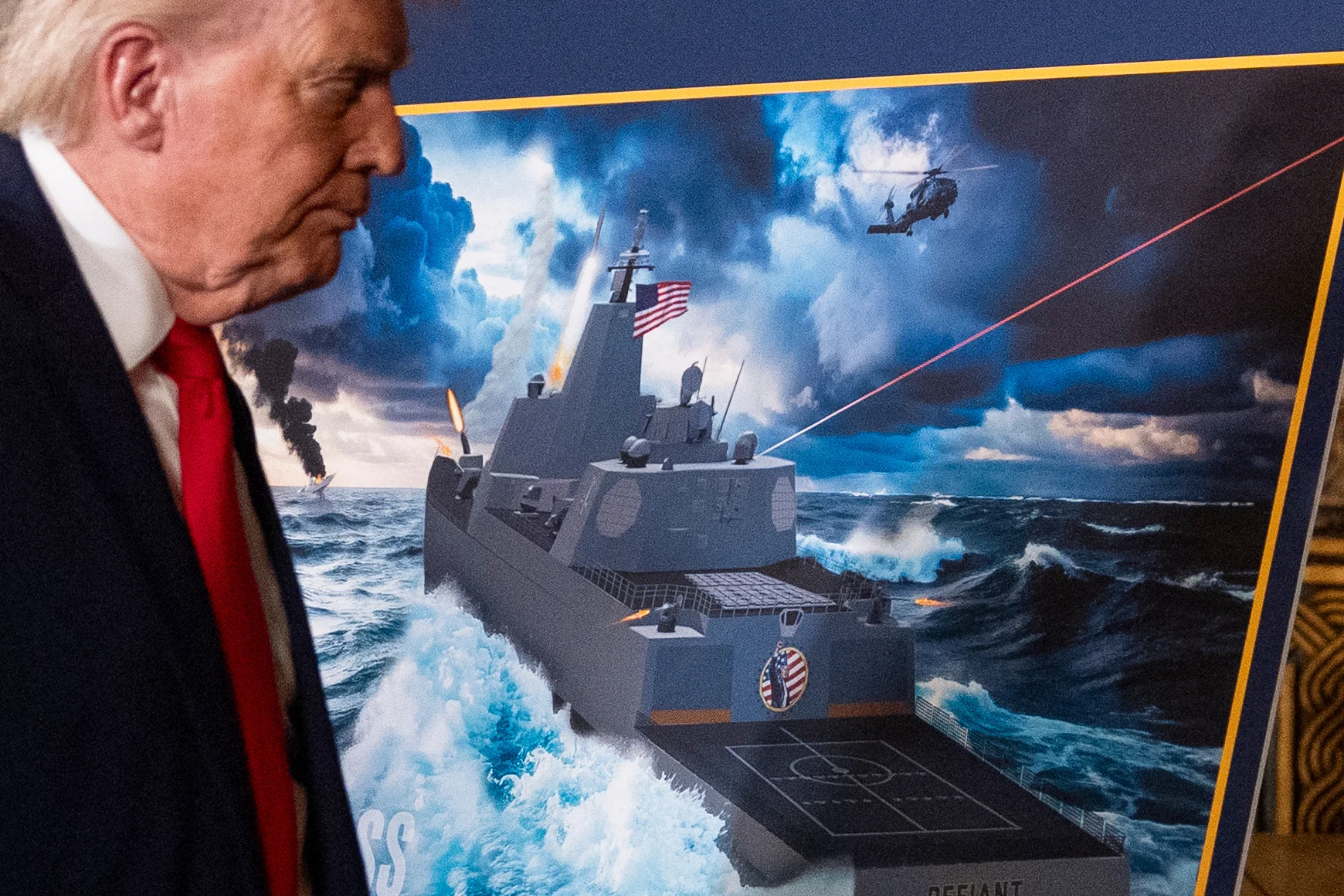
Trump Proposes a Bold Naval Vision: The USS Defiant and the “Golden Fleet”
In a daring announcement that has captured the attention of military analysts and enthusiasts alike, former President Donald Trump unveiled plans for a new warship, the USS Defiant, as a key component of his grand “Golden Fleet” initiative. The vision aims to revitalize the U.S. Navy with cutting-edge technology and formidable power, positioning the United States as an indomitable force on the high seas.
A Revolutionary Battleship
During an event at his Mar-a-Lago estate in Florida, Trump described the USS Defiant as a “battleship” that would vastly outperform any ship currently in operation. He proclaimed, “They’ll be the fastest, the biggest, and by far 100 times more powerful than any battleship ever built.” This bold claim sets ambitious expectations for a vessel that aims to integrate advanced military technology.
Incorporating Cutting-Edge Technologies
According to Trump, the USS Defiant will dwarf the legendary Iowa-class battleships of World War II in size. With plans to arm it with hypersonic missiles, nuclear cruise missiles, rail guns, and high-powered lasers, the Navy is aiming to harness technologies that are still in various stages of development. For instance, hypersonic weaponry promises unprecedented speed, while railgun technology has faced setbacks; the Navy abandoned its railgun project in 2021 after years of investment.
Despite the innovative aspirations surrounding the USS Defiant, challenges loom large. The development of nuclear cruise missile capabilities may conflict with international non-proliferation treaties, complicating the naval landscape further.
The Shift from Traditional Battleships
Traditionally, “battleship” refers to heavily armored vessels equipped with large-caliber guns, and the historical context can’t be ignored. The Iowa-class battleships, weighing in at around 60,000 tons, played pivotal roles during WWII but were decommissioned by the 1990s as naval warfare evolved. The rise of aircraft carriers and long-range missiles marked a paradigm shifts in naval strategy. Trump’s proposed battleship appears to redefine this term: although it retains some of the essence of its predecessors, it will use modern missile technology instead of traditional naval artillery.
A Logistics and Technological Challenge
The announcement follows a period of turmoil within the Navy, which recently scrapped plans for a new small warship due to delays and budget overruns. The decision to pivot toward a modified version of a Coast Guard cutter underscores ongoing challenges in fleet modernization. As the Navy grapples with technological development, the promise of hypersonic missiles and sophisticated lasers remains laced with uncertainty.
Interestingly, laser technology has seen some success, with defensive systems now aboard several destroyers. However, the Navy’s ambitious aspirations for further technologies must be tempered by the realities of budgeting and implementation timelines.
The Vision Behind the Golden Fleet
The newly launched website for the “Golden Fleet” echoes Trump’s aspirations to reignite the Navy’s capabilities, indicating that the USS Defiant will weigh about 35,000 tons with a significantly smaller crew than its predecessors—between 650 and 850 sailors. This reduction aligns with modern naval needs, where automation and technology can offset the need for larger crews.
Trump’s deep involvement in the project indicates a hands-on approach to the design of the USS Defiant. During his presidency, he expressed a keen interest in the aesthetics of Navy vessels, even suggesting designs and changes to existing ships.
Meeting Modern Military Needs
Navy Secretary John Phelan echoed Trump’s enthusiasm, suggesting that the new USS Defiant will inspire awe and respect whenever it docks in foreign ports. This statement reinforces the proposed ship’s intended role, breathing new life into U.S. naval presence and power projection.
However, questions linger: will the ambitious plans for the USS Defiant materialize in the form of a truly revolutionary vessel, or will they become yet another entry in a long list of unmet military aspirations? The timeline for construction is projected to begin in the early 2030s, but the effectiveness of this grand vision remains to be seen.
In summary, the announcement of the USS Defiant signifies more than just a new addition to the Navy’s fleet; it represents a bold ambition to redefine naval power in the modern era. As discussions of design and technology begin to unfold, the eyes of military analysts and the public alike will remain fixed on what comes next in this audacious endeavor.