


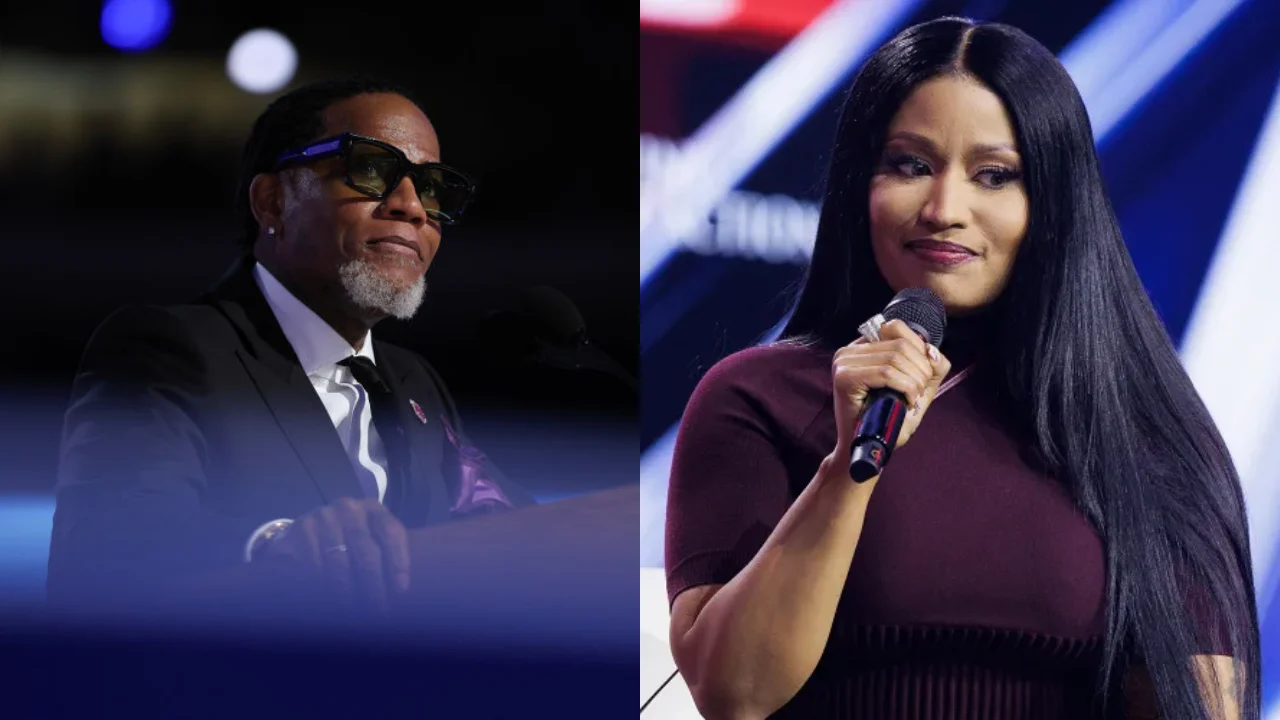
D.L. Hughley on the Irony of Celebrity Politics: A Closer Look
D.L. Hughley, a renowned comedian and actor, recently took to social media to dissect a striking instance of irony involving pop star Nicki Minaj and her unexpected appearance at Turning Point USA’s AmericaFest. Minaj’s participation sparked controversy, particularly given her comments on children’s issues that seemed in direct conflict with the values of the organization founded by the late Charlie Kirk. Hughley’s response to this situation highlights the complexities of celebrity influence in political discourse.
Nicki Minaj’s AmericaFest Appearance
When Nicki Minaj stepped onto the stage at AmericaFest, her presence was met with both applause and criticism. The venue, associated with Turning Point USA, is known for its conservative stance and often contentious views on issues like immigration and education. Minaj’s remarks about the current president and her advice to children raised eyebrows, especially considering her previously vocal critiques of policies aimed at supporting transgender youth.
As clips of her speech circulated, many found the juxtaposition of her background—as a child of immigrants from Trinidad and Tobago—with Kirk’s hardline views ironic. This led Hughley to point out the dissonance not just in her appearance but in the very fabric of the event itself.
Hughley’s Sharp Critique
Hughley’s commentary was immediate and incisive. In a video response, he articulated the contradictions inherent in Minaj’s newfound alliance with a movement that staunchly opposed figures like her. Hughley replayed older clips of Kirk denouncing Minaj as a poor role model for young Black girls, underscoring the hypocrisy of turning to her now for support.
His observations reveal a deeper hypocrisy in how individuals and movements adapt their stances for what he described as “transactional” alliances. For Hughley, this wasn’t merely about Minaj; it was a commentary on shifting ideological ground when it served individuals’ interests.
Transactional Politics and Selective Outrage
Hughley expressed amazement at how members of the MAGA movement were willing to forsake their principles for personal gain. He characterized this shift as a convenience rather than a genuine alignment of beliefs. According to him, the selective outrage that often characterizes political discourse misses the mark, especially as it relates to marginalized groups.
Moreover, he contrasted the fervor directed towards transgender issues with the lack of similar outrage aimed at more pressing concerns, such as sexual exploitation. By bringing Minaj’s family history into the conversation—her husband being a registered sex offender and her brother convicted of child rape—Hughley emphasized that perhaps the focus should be elsewhere.
Prior Conflicts: Minaj vs. Hughley
This isn’t the first instance of tension between Hughley and Minaj. Recently, following her disparaging remarks aimed at California Governor Gavin Newsom—who has fortified his record of supporting transgender rights—Hughley countered that Minaj’s family background undermined her credibility on matters concerning the welfare of children.
Minaj’s dismissive attitude towards Newsom’s advocacy for trans youth drew sharp rebuke from Hughley, who challenged her assertions. His point was clear: Given her complicated family circumstances, Minaj’s commentary on children’s issues appeared not only inconsistent but also ironic.
The Broader Implications of Celebrity Influence
At AmericaFest, Minaj further fanned the flames of debate with her remarks to young girls about embracing their appearance and her use of the phrase “boys will be boys.” These statements added layers to the ongoing conversation about gender norms and societal expectations, resulting in a wave of critiques ranging from outrage to support.
Hughley posited that the real concern isn’t merely about an individual like Minaj; instead, it’s about the broader implications of how political ideologies can be warped to welcome celebrity influence. His perspective suggests that when celebrity and ideology intersect, the essential tenets of a movement can quickly become secondary to the allure of fame and charisma.
In examining these interactions, Hughley effectively raises questions about the very nature of political alignments and their implications. If politics is indeed a theater, then the involvement of celebrities like Minaj serves not only as entertainment but also as a reflection of the shifting narratives and values that define contemporary discourse.