


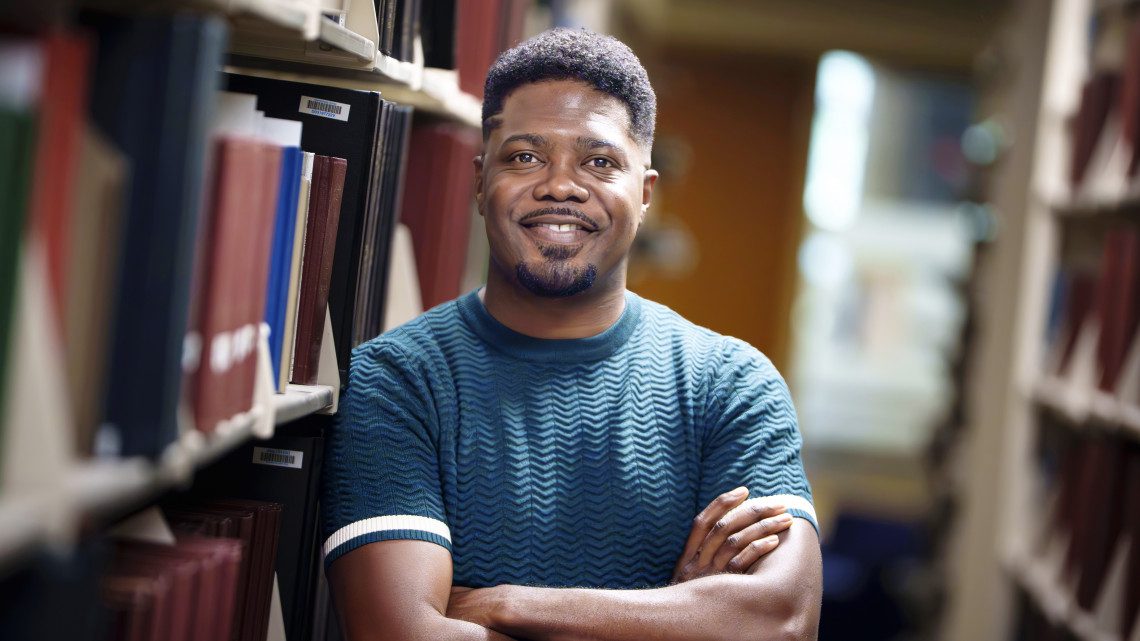
In today’s post, Dr. Robert Greene II, Former AAIHS President and Associate Professor of History at Claflin University, interviews Dr. Jarvis C. McInnis about his book, Afterlives of the Plantation: Plotting Agrarian Futures in the Global Black South (Columbia University Press, 2025). Dr. McInnis is an Associate Professor of English at Duke University, and is an interdisciplinary scholar who studies the African American and African Diasporic experiences. Dr. McInnis has been published at Callaloo, Mississippi Quarterly, Public Books, MELUS, and The Global South. Afterlives of the Plantation is a finalist for the 2026 Pauli Murray Book Prize, which recognizes the best book on Black intellectual history.
Please join us on Friday, January 30th at 12 Noon Eastern for a virtual conversation with Prof. McInnis about his new book. Click here to register.
Inspiration Behind the Book
Dr. Jarvis C. McInnis shares the motivations for his debut book, Afterlives of the Plantation, revealing how his personal history as a native of Gulfport, Mississippi deeply influenced his perspectives. The author reflects on his experiences at Tougaloo College, an historically Black institution, where he became aware of the vast cultural and intellectual contributions of Black individuals from the South. This awareness juxtaposed against his time in New York sparked crucial questions about the narratives surrounding Black Southerners, particularly those who remained in the South or returned after migration.
McInnis articulates a significant tension he faced: the pervasive anti-Southern bias both personally and academically, which cast the South—especially Mississippi—in a negative light. He emphasizes the necessity to redefine Black Southern identities beyond stereotypes of backwardness, recognizing their substantial contributions to culture and modernity.
Global Black South: A Conceptual Shift
In one of the book’s pivotal themes, McInnis discusses what he terms the “Global Black South,” a reimagining of how we perceive the relationship between Black Southerners and their counterparts across the globe. Studying under Professor Farah Jasmine Griffin led him to examine Zora Neale Hurston’s work, which illuminated the connections between the U.S. South and the Caribbean, fundamentally altering his understanding of the region’s role in modernity. Rather than viewing Southern Black identity and the diaspora in isolation, he proposes an interconnected perspective that asserts their foundational roles in shaping global narratives.
McInnis cautions that scholarship often underrepresents immobile Black experiences, focusing so heavily on migration that it neglects the narratives of those who chose to stay. Merging concepts of rootedness and modernity, he challenges prevailing assumptions in Black Studies, arguing that Black Southern identity holds intrinsic modernity, which is often overlooked.
Tuskegee’s Role in Modern History
McInnis examines the complicated legacy of Tuskegee University, arguing for its re-examination within the historical narrative as a center of global Black thought. Initially hesitant, he delved into Tuskegee’s archives and recognized its broader cultural significance. He argues that Tuskegee was not merely a manual training institution; instead, it exemplified agricultural, aesthetic, and intellectual innovations instrumental in shaping Black identity in the late nineteenth to early twentieth centuries.
Along the way, he encountered rich narratives of Tuskegee’s influence extending to countries like Cuba and Haiti, through agricultural practices and education, illustrating its role in the cultivation of Black consciousness and empowerment.
Reassessing Booker T. Washington
Booker T. Washington’s complex legacy serves as a vital component of McInnis’ argument. Often relegated to a controversial figure due to his accommodationist politics, Washington is reassessed not just as a product of his time but as a symbol of self-help and race pride among many Black individuals—both within the U.S. and abroad. McInnis highlights that Washington’s vision for Black advancement continued to resonate, offering valuable insights into global expressions of freedom at the turn of the twentieth century, even while acknowledging his shortcomings.
The characterization of Washington shifts from a singular narrative to one of multifaceted interpretations. While critiquing his methodologies, McInnis emphasizes Washington’s significant role in forging pathways forward for countless Black individuals navigating systemic oppression.
Importance of Women in the Narrative
Critical to McInnis’ work is his commitment to centering Black womanhood in the discourse surrounding the agricultural and industrial legacy of Tuskegee. He discusses figures like Margaret Murray Washington, who played pivotal roles in the institution’s formation and growth, challenging the historical tendency to prioritize male contributions over women’s roles. By focusing on women’s involvement, McInnis redistributes the narrative, spotlighting their intellectual contributions and transformative roles within the Tuskegee model of New Negro identity.
Engaging with Black feminism, he argues for recognizing the agency of women like Clara Shepard, who crafted diasporic understandings among her students, thereby shaping future generations within the broader agricultural and educational landscape.
Legacy of HBCUs in Shaping Black Scholarship
As a graduate of Tougaloo College, McInnis has a personal and professional commitment to uplifting HBCUs in conversations about Black intellectual and cultural life. He emphasizes the significant impact these institutions had in shaping leaders across various movements, particularly those critical to the development of Black identity in the U.S. and the broader African diaspora.
In his exploration of Tuskegee, McInnis seeks to rectify the often-overlooked histories of HBCUs and their contributions, returning to the rich tapestry of African American scholarship that has long been woven within these institutions.
Ultimately, McInnis endeavors to anchor today’s understanding of Black modernity in the realities of historically Black institutions, challenging readers to reevaluate their preconceived notions while broadening their appreciation for the cultural and intellectual processes that have shaped the Black experience.