


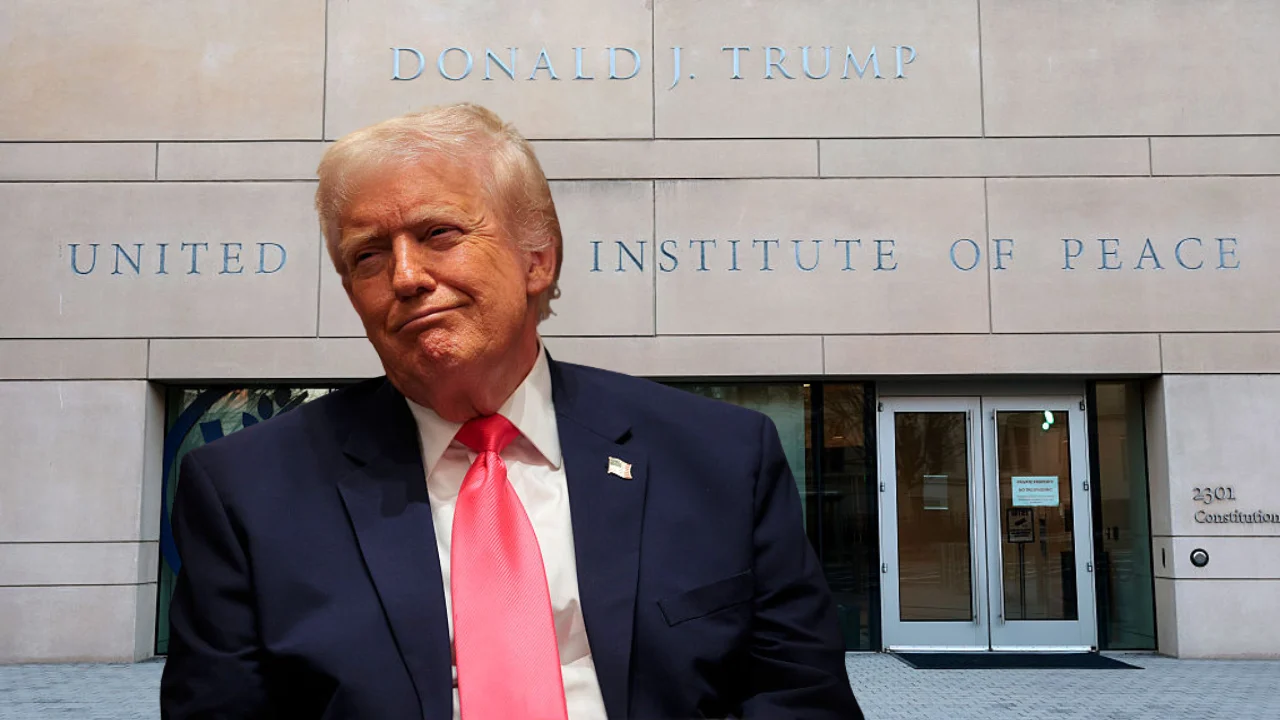
The recent peace deal signing between Rwanda and the Democratic Republic of Congo (DRC) at the U.S. Institute of Peace has garnered widespread attention, not just for its significance in the region, but also for the unexpected presence of former President Donald Trump’s name now prominently displayed at the institute’s headquarters in Washington, D.C. This naming change, which is officially recognized, marks a striking turn of events, especially considering the institute’s history and mission.
Many attendees of the peace deal signing observed the new signage, notably featuring Trump’s name above the main entrance of the U.S. Institute of Peace. This alteration, celebrated by Trump during the signing ceremony, emphasizes a somewhat controversial relationship between the former president’s administration and the institute’s foundational principles. The event itself, aiming to conclude a decades-long conflict, took on an added layer of irony with Trump’s endorsement. “Boy, that is beautiful,” Trump remarked, thanking his Secretary of State, Marco Rubio, who authorized this transformation of the institute’s identity.
However, this change has not come without pushback. Critics, including Democratic lawmakers and human rights advocates, have voiced their disapproval, highlighting a paradox in the former president’s foreign policy approach. Trump’s previous threats of military action, particularly aimed at nations like Venezuela, have led to questions about his commitment to fostering peace. Such contradictions raise eyebrows and spark debates about the implications of associating Trump’s name with an institution aimed at conflict resolution.
Adding to the complexity, in February of the same year, Trump signed an executive order seeking to dismantle the U.S. Institute of Peace. This move aimed to terminate the leadership and staff at the institute, a decision currently pending in federal court. The juxtaposition of attempting to erase the institute’s existence while simultaneously placing his name on it left many observers puzzled. Christopher Shell, a fellow at the Carnegie Endowment for International Peace, commented on this irony. He noted that it is difficult to understand the motivations behind renaming the institute, particularly before the signing of a crucial peace agreement.
Established by Congress in 1984, the U.S. Institute of Peace was designed with a vision of promoting global peace through education and policy-making. Its governance has traditionally included a bipartisan board, giving equal importance to voices across the political spectrum. The institute itself has served as a platform for diplomacy, aiding efforts in conflict zones and fostering international cooperation. The recent name change raises important questions about the future direction of the institute and what it means for its mission.
Shell highlighted the contradictions present in Trump’s foreign policy, where he positions himself as a broker of peace while paradoxically escalating tensions in various global regions. For example, as Trump celebrates agreements such as the Washington Accords, his administration’s approach in Latin America seems to suggest a different narrative, emphasizing military action over diplomacy. This duality underscores a broader theme in Trump’s presidency: that his conception of peace may vary significantly based on geopolitical considerations.
The timing of the renaming also coincides with Trump being passed over for the Nobel Peace Prize in October, further complicating the narrative surrounding his foreign policy achievements. Despite his claims of significant contributions to peace negotiations, critics argue that these actions have often been overshadowed by divisive rhetoric and policies perceived as antagonistic or confrontational.
Trump has frequently compared himself to former President Barack Obama, who was awarded the Nobel Peace Prize in 2009. Trump’s assertions that he deserves similar recognition for his own diplomatic efforts have sparked backlash from multiple fronts. While some supporters argue that his approach to foreign relations has led to breakthroughs, critics highlight the lasting impact of his domestic policies, which they assert contradict the tenets of peace and unity that the Nobel Prize embodies.
In this context, Trump’s influence on the U.S. Institute of Peace raises fundamental questions about the integrity and direction of such institutions in a politically charged environment. Critics argue that true peacemaking requires more than mere deal-making; it demands a commitment to fostering understanding, cooperation, and healing, rather than division and strife.