


Witnessing Humanity: The Art of John Wilson and the Black Family Experience
As an art historian, the exploration of an artist’s work often takes an objective route, devoid of personal sentiment. Yet, in the case of John Wilson (1922–2015), my familial connection compels me to break from convention. Co-authoring this piece with my sister, Leslie, allows us to delve into Wilson’s profound portrayal of the Black family, particularly mothers, through a personal lens that mirrors our own upbringing.
The Intersection of Personal History and Artistic Reflection
Wilson’s artistry resonates deeply with our family’s narrative; our parents, just like Wilson and his wife Julia, entered into an interracial marriage in the tumultuous decade of the Civil Rights Movement, the 1950s. Both our mother, of Irish descent, and Wilson were shaped by their unique backgrounds; our mother studied at the City University of New York, while Wilson’s father emigrated from Guyana.
Interracial marriage presented significant challenges even for families like ours—families that traveled through the American South often faced the harsh reality of anti-miscegenation laws. Our own travel experiences exemplify this, dividing children by skin color as we navigated regions steeped in racism.
Black Motherhood and the Weight of Fear
Our shared experiences connect to the troubling realities depicted in Wilson’s art. Like the mothers in our neighborhood, our own mother faced ongoing concerns for her children’s safety. Particularly for our brother, the looming threat of police violence loomed large. In the 1960s and ’70s, despite being only 19% of New York City’s population, Black individuals constituted an overwhelming 59% of police-related fatalities.
This shared fear between our family and Wilson’s reflects a broader narrative of Black parents instinctively teaching their children how to navigate a hostile society—teaching them to speak deferentially to law enforcement in order to survive. Such experiences parallel the themes prevalent in Wilson’s early works, which vividly embody this tension within Black family structures.
Artistic Parallels: The Impact of Racial Violence
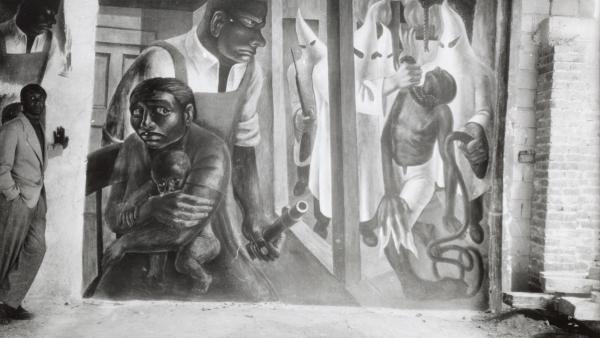
Wilson’s mural The Incident explicitly confronts issues of racial violence, examining its psychological toll on Black families. This piece serves as a stark representation of Black existence during the mid-twentieth century, juxtaposing the gruesome act of lynching against a domestic sphere. A terrified mother cradling her child amidst chaos depicts the constant vigilance required of Black mothers, a sentiment echoed in other works by artists like Elizabeth Catlett and Charles White.
Through these portrayals, Wilson elevates the universal themes of motherhood and familial love, while simultaneously addressing the harsh realities imposed by systemic racism. In The Incident, his mother figure holds her child protectively—a poignant reminder of both vulnerability and strength in the face of oppression.
Focusing on Female Experience: The Black Madonna
Wilson’s depictions of Black motherhood offer an alternative to the classical representations of the Madonna. Where traditional representations often emphasize serenity, Wilson’s mothers exhibit fear, tension, and a resolute determination to protect their children. Unlike the calm, composed figures typically depicted in Western art, Wilson’s mothers are juxtaposed with the horrifying reality of racial violence, redefining the representation of maternal figures in the art historical canon.
Other artists from the period, such as Meta Fuller and May Howard Jackson, also explored the intimacy of mother and child but fell short of capturing the inherent tension present in Wilson’s work. Jackson’s creations reference the womb-like safety of motherhood, but they lack the haunting resonances of racial violence that permeate Wilson’s portrayals.
The Ripple Effects of Violence: Maternal Stress and Public Health
Wilson’s The Incident opens a dialogue about the compounded stress experienced by Black mothers, a reality that manifests in current maternal health crises in the United States. As a Black mother myself, I cannot help but draw connections between Wilson’s art and the systemic inequities that plague many Black women today.
Modern studies highlight the alarming rates of maternal mortality among Black women, revealing that even those with access to wealth and education face disproportionate risks during childbirth. Such disparities do not stem from individual behaviors but are deeply rooted in a history of medical racism and oppression.
Confronting Obstetric Violence
The emotional weight of Wilson’s art lays bare the underlying truths about the systemic mistreatment of Black women in maternal care—a type of violence that persists in today’s medical system. The fear depicted in Wilson’s works reverberates throughout generations, illustrating ongoing mistrust and hostility toward healthcare institutions that have historically marginalized them.
The prevalence of obstetric violence—characterized by neglect, coercion, and discrimination—has deep roots in the history of Black reproductive health. Mistrust in the medical system persists not only because of past injustices but also due to ongoing experiences of mistreatment, shared by countless Black mothers as they anticipate childbirth.
A Call for Empathy and Action
Both Wilson’s art and our familial narratives seek to inform and inspire awareness surrounding the complexities of Black motherhood and the stark realities tied to race in America. The hope is that viewers can connect emotionally with the struggle illustrated in Wilson’s work, awakening their empathy and motivating broader social change.
As we navigate through the legacies of systemic oppression, it becomes ever more vital to learn from these artistic representations. Our story, mirrored in Wilson’s poignant depictions, invites all viewers to engage deeply with the art and its implications, seeking to foster understanding, healing, and ultimately, justice.
This exploration into John Wilson’s art provides a critical lens on the systemic issues faced by Black families, illuminating experiences that are often overlooked yet remain relevant in contemporary discourse. It highlights not just an artistic achievement but also a reflection of lived realities that deserve to be heard, acknowledged, and addressed.