


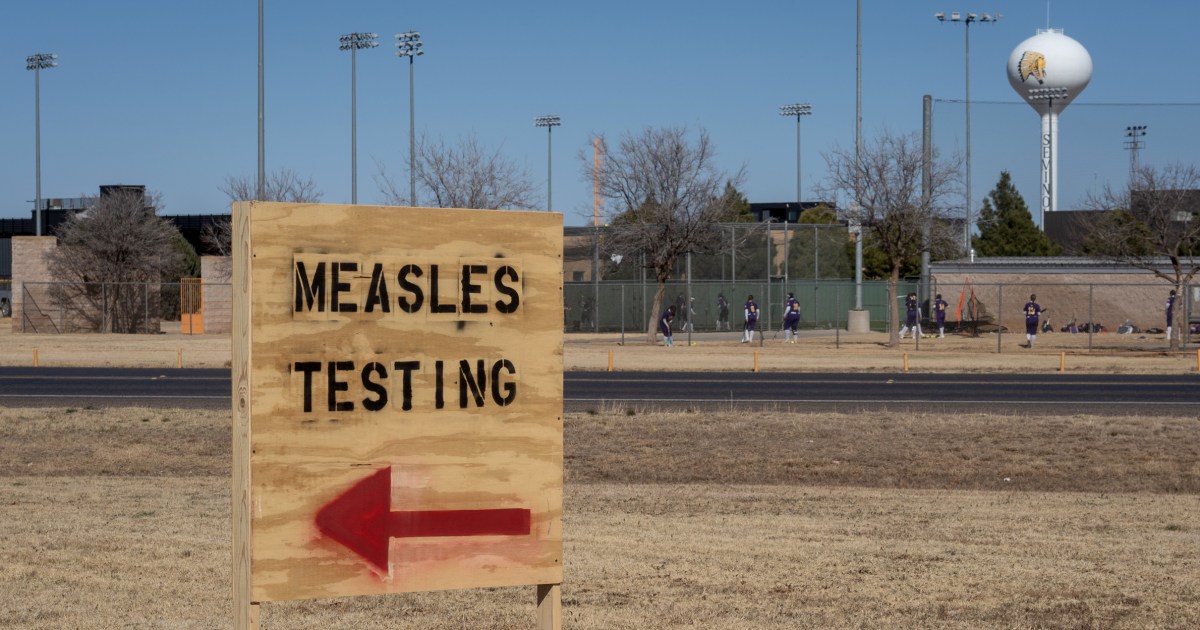
A Year After the West Texas Measles Outbreak: The Ongoing Spread of Measles in the U.S.
A year has passed since West Texas experienced a deadly measles outbreak, and troublingly, the virus continues to circulate in various parts of the nation. This development is significant; it raises concerns that the United States may no longer be able to claim that measles has been eliminated within its borders.
Historically, the U.S. has enjoyed a designation of measles elimination since 2000, indicating that the virus was not continuously circulating, though sporadic outbreaks could occur. However, global public health entities consider the virus endemic after a full year of uninterrupted transmission. The implications of this designation are severe, suggesting that the U.S. is on a precarious edge regarding public health.
Dr. Amira Albert Roess, a global health and epidemiology expert at George Mason University, encapsulates the situation: “We have all the ingredients to have our elimination status revoked.” This sentiment underscores just how unusual it would be for a country with robust healthcare systems like the U.S. to lose its elimination status—something usually seen in war-torn or collapsing nations.
In comparison to past years, 2025 proved to be devastating for measles cases. The Centers for Disease Control and Prevention (CDC) documented 49 outbreaks and a staggering 2,242 cases last year alone. Alarmingly, 171 cases have already been confirmed this month, indicating that the true number might be significantly higher due to the time lag in reporting.
At the moment, South Carolina stands as the focal point of the measles crisis. Since October, the state health department has reported 646 cases, highlighting the urgent need for public awareness and vaccination efforts.
The ultimate determination of the U.S.’s elimination status will be made by the Pan American Health Organization (PAHO) later this year. Noel Brewer, a public health professor at the University of North Carolina, points out that a thorough analysis of the U.S. measles response will precede this judgment. “2025 was the year of measles,” he notes, pondering whether 2026 will mark a decline in cases or further deterioration.
Despite the increased incidence of measles, experts like Brewer indicate that the U.S. might not automatically lose its elimination status; it’s crucial that the same strain spreads continuously for over a year before such a designation is revoked. He offers a semblance of hope amid the chaos, suggesting that 2026 is not definitively lost yet.
However, the contradiction arises from the alarming statements made by health officials such as Dr. Demetre Daskalakis, who expresses a more fatalistic view. He states outright, “Elimination is already lost,” emphasizing that the current trajectory shows uncontrolled spread.
The situation is further complicated by recent events in neighboring Canada, which lost its elimination status after over 5,000 cases since late 2024. This underscores a worrying trend observed across North America: declining vaccination rates. Experts emphasize that falling rates of immunization are the primary driver behind these resurgent measles outbreaks. The virus’s highly contagious nature means that if someone is exposed without immunity—whether from vaccination or prior infection—upward of 90% of those individuals may contract it.
Symptoms of measles begin with high fever, cough, and runny nose before evolving into red, watery eyes and the characteristic splotchy rash. In some tragic cases, measles can lead to severe complications, including pneumonia and brain inflammation.
For the past 25 years, measles vaccination rates in the U.S. have been high enough to prevent widespread transmission. Yet now, many states report vaccination coverage dipping below the crucial 95% threshold required to curb the spread. In the 2024-2025 school year, 39 states recorded vaccination rates below this vital level—up from just 28 states pre-COVID.
Recent studies have indicated that exemptions for vaccinations based on personal beliefs are becoming increasingly common. Many counties are now seeing steady increases in such exemptions, further jeopardizing communal health and safety.
The current administration’s stance on vaccination policies has also come under scrutiny. Under Health Secretary Robert F. Kennedy Jr., federal health agencies have positioned vaccination as a personal choice, thereby diluting the urgency often associated with immunization campaigns. This shift has led to concerns from within public health circles about the lack of a concerted effort to push vaccinations.
Kennedy’s mixed messaging—advocating for vaccinations while simultaneously promoting unproven alternative treatments—creates confusion and uncertainty within the community. While acknowledging the effectiveness of measles vaccines, he has propagated misinformation regarding their longevity, which counters established scientific consensus.
As the situation continues to evolve, many experts like Dr. Roess lament, “We kind of deserve to lose our elimination status because everything we’re doing is unraveling it.” This sentiment reveals a profound recognition that continued inaction and public apathy toward vaccination could lead to dire public health consequences.
The battle against measles is far from over, and the coming months will be crucial in shaping the future of public health in the U.S. and beyond.