


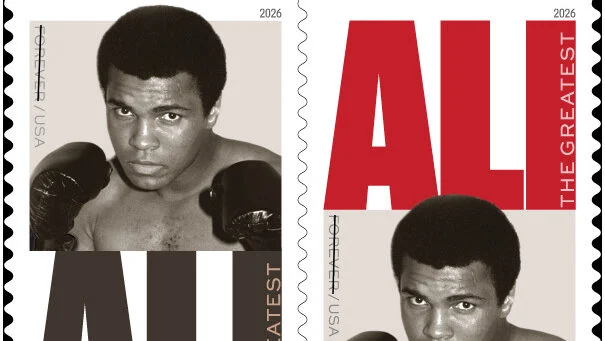
Muhammad Ali once joked that he should be a postage stamp because “that’s the only way I’ll ever get licked.” This humorous quip is now transcending from jest to reality, honoring the legacy of one of the most iconic figures in sports history.
Ali, widely regarded as the most famous and influential boxer of all time, is being honored for the first time with a commemorative U.S. postage stamp. Known not just for his unmatched athletic prowess but also for his cultural impact, he seamlessly unified athletic brilliance with political conviction and unparalleled showmanship. As a cultural force, Ali has inspired generations, making the stamp a fitting tribute.
“As sort of the guardian of his legacy, I’m thrilled. I’m excited. I’m ecstatic,” Lonnie Ali, the champ’s wife of nearly 30 years, shared with The Associated Press. She highlighted how this stamp serves as a tool for collective memory, saying, “Every time they look at that stamp, they will remember him.” Lonnie believes that the stamp can reinforce the compassion Ali exemplified throughout his life and encourage connections among people.
A Fighter in the Ring and Compassionate in Life
Muhammad Ali passed away in 2016 at the age of 74 after bravely battling Parkinson’s disease for over three decades. During and after his life, Ali garnered numerous accolades, including an Olympic gold medal in 1960, the United Nations Messenger of Peace award in 1998, and the Presidential Medal of Freedom in 2005. The significance of his face on a stamp resonates deeply with Lonnie Ali, as it highlights his mission of compassion and his ability to connect with individuals on a personal level. “He did it one person at a time,” she remarked, emphasizing the quaint yet profound nature of letter writing and the connection it fosters.
Stamp to Be Publicly Unveiled
The official unveiling of the Muhammad Ali Forever Stamp is scheduled for a first-day-of-issue ceremony in Louisville, Kentucky, Ali’s birthplace. This momentous event will take place at the Muhammad Ali Center, which celebrates his remarkable life and legacy. At this ceremony, attendees can purchase the new stamps featuring a compelling black-and-white photo from 1974 of Ali striking his iconic boxing pose.
Each sheet comprises 20 stamps, also showcasing an image of Ali dressed in a pinstripe suit, symbolizing his pivotal role as an activist and humanitarian. A total of 22 million stamps will be printed, with no plans for reprints once they sell out, making them highly sought after by collectors and fans alike.
Because they are Forever Stamps, they maintain their value as First-Class Mail postage indefinitely. Lonnie Ali describes this as the “ultimate” tribute, stating, “This is going to be a Forever Stamp from the post office. It will be part of his legacy, and it will be one of the shining stars of his legacy.”
Creating a Historic Stamp
The inception of the Muhammad Ali stamp began shortly after his passing nearly a decade ago, though the journey from idea to execution is a lengthy one. The United States Postal Service (USPS) mandates that individuals featured on stamps must have been deceased for a minimum of three years, except for presidents. During this time, a friend of Ali initiated the #GetTheChampAStamp campaign, which intensified public interest and support for the idea.
Lisa Bobb-Semple, the USPS director of stamp services, expressed her excitement about finally bringing the stamp to fruition, noting that there was always a desire to honor Ali in this way. The Citizen Stamps Advisory Committee plays a vital role in determining stamp subjects, meeting quarterly to evaluate suggestions from the public. Each stamp undergoes a meticulous approval process, ensuring a high standard of artistic and historical significance.
Art director Antonio Alcalá shared that the design process involved sifting through hundreds of images before selecting those that best encapsulated Ali’s essence. Ultimately, the chosen AP photograph features a powerful image of Ali in his prime, capturing his fierce spirit and determination.
A Candid Figure on War, Civil Rights, and Religion
Beyond the boxing ring, Ali made headlines for his candid perspectives on crucial issues such as race, religion, and conflict. Born Cassius Clay Jr., he changed his name upon converting to Islam in the 1960s, becoming a vocal advocate for civil rights. His refusal to be inducted into the U.S. Army in 1967, based on his religious beliefs and opposition to the Vietnam War, cost him his championship title and barred him from boxing for more than three years. Nevertheless, his conviction was eventually overturned by the U.S. Supreme Court in 1971, solidifying his status as a global icon.
In his later years, Ali transformed into a global humanitarian, using his fame to champion charity, peace, and religious understanding, even as he battled the effects of Parkinson’s disease.
Ali’s Message During a Time of Strife
The release of this commemorative postage stamp coincides with a period marked by political division in the U.S. and around the globe. Lonnie Ali observed that if her husband were alive today, he would remain shielded from negativity, focusing instead on fostering compassion and connection with others. “We have to mobilize Muhammad’s life and sort of engage in the same kinds of acts of kindness and compassion that he did every day,” she stated, reminding us of the importance of compassion in today’s world.