


Charlie Kirk: Martyr of a New Christian Nationalism
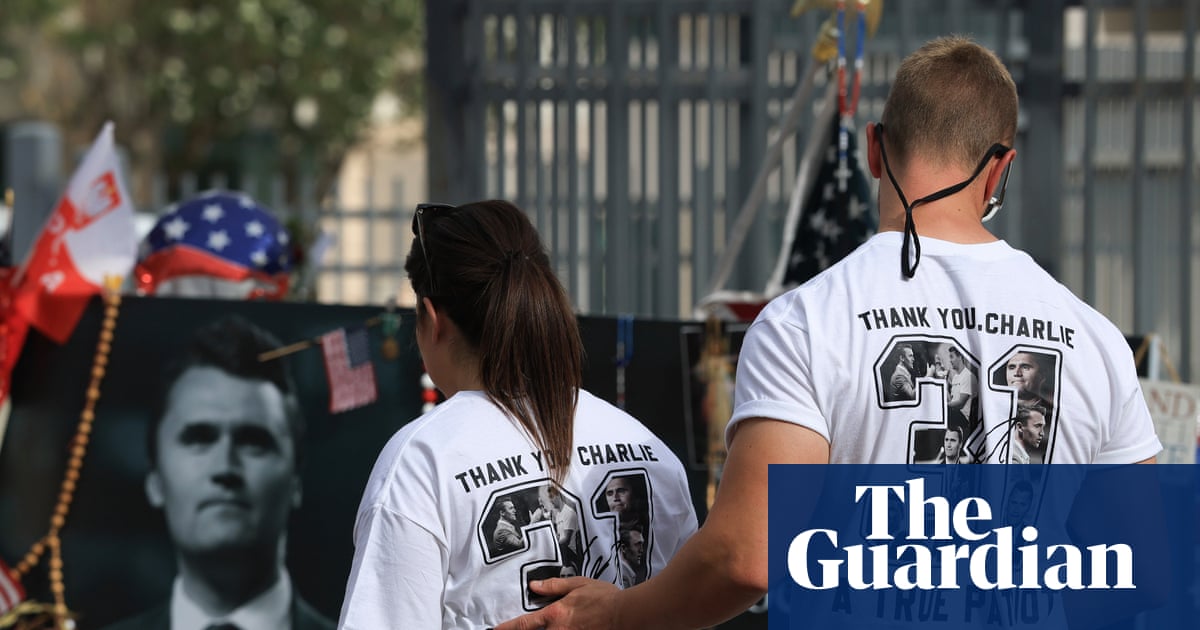
Christian nationalists in the United States have increasingly positioned Charlie Kirk as a martyr for a movement that has surged in popularity alongside his political rise. After recent violence claimed his life, his widow, Erika Kirk, took to social media to express her profound sorrow, stating, “the world is evil, but God is ‘so good.’” She described her grief as a “battle cry,” suggesting this tragic event has ignited a powerful response within the community aligned with her late husband’s ideals.
The Sorrow of a Grieving Widow
In the wake of Kirk’s death, Erika’s public expressions of sorrow have drawn significant attention. Jeff Sharlet, a scholar well-versed in Christian nationalism and the far-right, noted the implications of her remarks. “That’s holy war, that’s accelerationism,” he observed, highlighting that the emotional context of a widow’s anguish can galvanize followers in compelling ways. While her pain is undeniably real, the way it is reframed within a larger ideological context raises questions about the motivations behind such rhetoric.
Christian Martyrdom in Conservative Circles
While Kirk was most well-known for his non-religious political activism, the conservative eulogies following his death have emphasized his Christian faith. Some commentators have even framed his demise as martyrdom, appealing to a narrative of sacrifice for conservative Christian values. Sean Feucht, a pastor and prominent figure in the Christian nationalist movement, stated, “The blood of the martyrs is the seed of the church,” inferring that Kirk’s death should inspire further activism and courage among believers.
Megachurch pastor Matt Tuggle echoed this sentiment, suggesting that pastors who fail to address the “evil demonic belief system” of the left are leading their congregations astray. This kind of rhetoric not only elevates Kirk to a martyr status but galvanizes the community to fortify its resolve against perceived threats.
A Microcosm of Trump-Era Christian Nationalism
Kirk’s rapid ascent in the political landscape mirrors the rise of Trump-era Christian nationalism, which has fundamentally altered the dynamics of political conservatism in America. Initially, Kirk presented himself as a secular young Republican. However, over time, he became increasingly intertwined with a culture war frame, speaking of a spiritual battle involving “Christendom” and threats from leftism and Islam.
Turning Point USA, an organization he founded, also evolved its messaging to align more closely with Christian nationalist ideals. The shift occurred during a pivotal moment when mainstream Christian conservatives felt alienated and demoralized, making them susceptible to more extreme ideologies. Matthew D. Taylor, a scholar of contemporary Christianity, noted that the failure of traditional political strategies left many yearning for a stronger, more aggressive representation.
The Spectrum of Christian Nationalism
Christian nationalism as a movement exists on a spectrum that spans from mainstream cultural conservatism to extreme religious supremacy. Its defining characteristics can be elusive, as it often manifests more as a mindset rather than a structured organization. Historically, groups like the Moral Majority relied on electoral politics to achieve their goals, but the landscape shifted significantly following significant electoral defeats and landmark judicial rulings favoring progressive social changes, such as the legalization of same-sex marriage.
Kirk’s embrace of more radical ideologies corresponded to the urgent calls for a robust defense of conservative values. When Donald Trump emerged as a candidate, he resonated with Christian evangelicals by presenting himself as a champion who would “speak for you” and “defend you.” This alliance proved pivotal in the transformation of Christian conservatism into a more aggressive identity politics.
The Influence of the New Apostolic Reformation
Under the Trump administration, the relationship between religion and politics took on new dimensions, with the rise of figures from the New Apostolic Reformation (NAR) gaining influence. This movement, characterized by its belief in modern-day prophets and apostles, advocated for societal transformation through conservative Christian governance. Kirk’s embrace of NAR ideas illustrates a broader trend where evangelical Christianity intertwines with a pursuit of political dominion, often sidelining traditional democratic processes.
The “seven mountains mandate” associated with the NAR advocates for Christians to take leadership roles across various sectors—including government, media, and education—to promote a distinctly Christian governance. Many supporters view this initiative as a divine directive, enabling them to push their values from positions of power rather than relying solely on popular support.
Kirk’s Political Evolution: A Strategic Realignment
Kirk’s political evolution highlights the shifting landscape of Christian nationalism. Earlier in his career, he emphasized the importance of church-state separation. But as the political climate grew more combative, he adopted more aggressive rhetoric that aligned with the NAR’s ideas. He reframed this relationship at forums like the Conservative Political Action Conference, where he underscored the need for Christian influence in addressing societal issues.
As a result, Turning Point USA began to forge partnerships with various church organizations and engage in grassroots activism that blurred the boundaries between religious and secular conservatism. Kirk recognized that within this evolving landscape, a robust image of Christian dominionism could appeal to a wider audience, normalizing concepts previously viewed as fringe.
Christian Nationalism Beyond the Pulpit
The allure of Christian nationalism extends beyond traditional religious boundaries. Many secular conservatives now express affinity for the movement’s symbolism and ideologies, even if they don’t actively participate in religious services. Kirk’s approach to merge these worlds allowed him to create an “influencer-lifestyle Christian nationalism” that appealed to a broader demographic, enabling people to adopt these beliefs without fundamentally altering their lifestyles.
Kirk’s declarations about the importance of maintaining a strong faith echo a larger theme within the movement: that society’s decline is linked to a distancing from Christian values. This framing positions secularism as not merely a cultural shift but a dire threat needing rectification through assertive Christian engagement in the public sphere.
Through this lens, Kirk’s life and untimely death reveal the complexities of a movement that is as much about faith as it is about power, resonating deeply amidst a backdrop of societal change and polarization.