


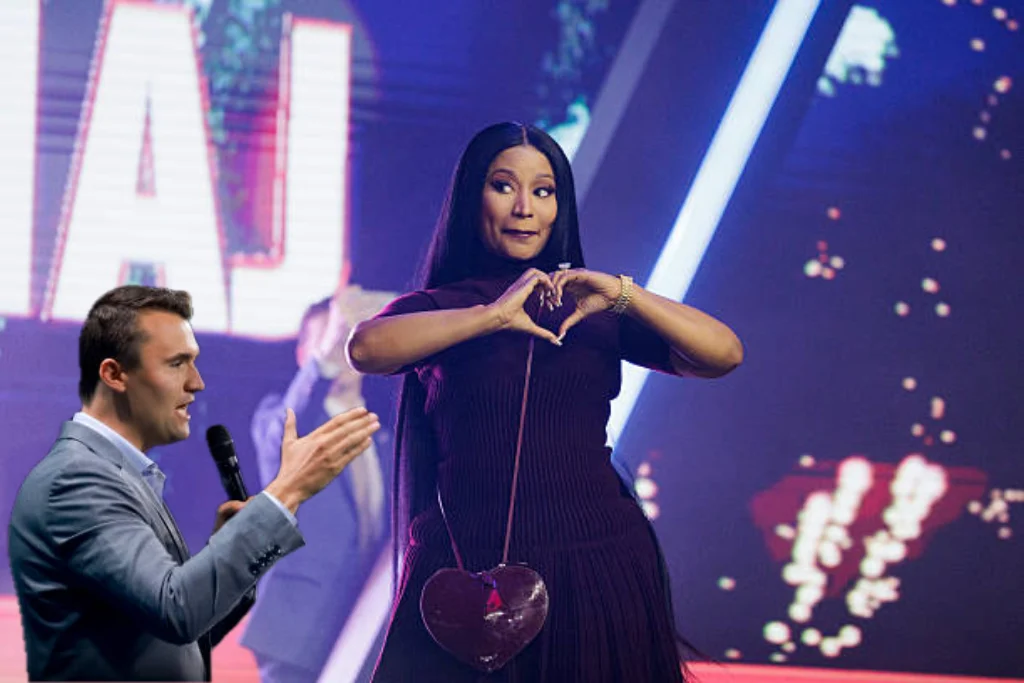
The Controversy Surrounding Charlie Kirk and Nicki Minaj
A resurfaced video featuring the late Charlie Kirk has sparked renewed discussions regarding his opinions on Black culture and the role models present within it. Kirk’s comments, made during a “Prove Me Wrong” campus tour, highlighted his beliefs on the impact of popular figures like Nicki Minaj on young Black girls, igniting conversations around accountability, representation, and political alliances.
Kirk’s Critique of Role Models
In the controversial footage, Kirk expressed a strong sentiment that certain cultural influencers do not serve as positive role models for Black girls. Specifically, he identified them as being “held captive by influences, songs, and role models,” indicating a belief that certain messages prevalent in hip-hop culture are damaging. He went so far as to question Minaj’s influence directly, asserting, “I don’t think that’s a good role model for 18-year-old Black girls,” and referenced the widely debated song “WAP” by Cardi B and Megan Thee Stallion, erroneously attributing it to Minaj.
This moment not only reveals Kirk’s perspectives but also showcases how figures like him often attempt to voice authority on issues facing minority communities, despite being outside those communities themselves.
Misguided Comparisons and Stereotypes
Kirk’s argument relied heavily on problematic comparisons. He likened contemporary female rappers to “role models of the 1940s and 50s for Black America,” without identifying who those role models might be. His failure to provide concrete examples undermines his argument and raises questions about his understanding of Black history and culture. The implications of his rhetoric, particularly by a white man discussing the lives and experiences of Black women, can come across as both patronizing and uninformed.
Kirk’s Controversial Legacy
The implications of Kirk’s comments extend beyond his critiques of musical artists. Known for his outspoken opinions, he faced widespread criticism for labeling issues within the Black community as “captivity” under cultural influences. His narratives often included derogatory remarks about Black individuals, painting them in a negative light and aligning himself with more racially charged stereotypes. Kirk’s final statements before his assassination only further illuminated his contentious views, specifically regarding violence and race.
For instance, he faced backlash for suggesting that he questioned the relevance of mass shooting statistics in relation to “gang violence,” highlighting a troubling dismissal of systemic violence experienced within marginalized communities. His comments about prominent figures like Joy Reid and Ketanji Brown Jackson, accusing them of “stealing” opportunities, revealed a pattern of dismissive rhetoric aimed at those advocating for equality.
Minaj’s Changing Political Alliances
In the aftermath of Kirk’s comments, discussions intensified around Nicki Minaj’s own political affiliations, particularly her recent praise for former President Donald Trump and other right-wing figures. At a recent Turning Point USA event, she appeared alongside Kirk’s widow, Erika Kirk, raising eyebrows across the political spectrum. During her speech, Minaj characterized Trump as “dashing” and made an unfortunate analogy involving the term “assassin” when referencing Vice President JD Vance.
This shift to support Republican ideologies has put Minaj at odds with her traditionally liberal fanbase, leading some critics to label her a “pedophile protector.” Such rhetoric showcases the contentious atmosphere surrounding her increased visibility in right-leaning circles.
The Broader Cultural Discussion
The intertwined narratives of Charlie Kirk and Nicki Minaj illuminate the cultural tensions within the Black community concerning representation and authenticity. Kirk’s disparaging remarks about Minaj highlight a broader critique directed toward those who challenge traditional political narratives. His assertions have now become fodder for social media critiques, as many users view the resurfaced clip as an opportunity to question Minaj’s integrity and choice of allies.
Kirk’s historical comments about Minaj also underscore a belief that Black figures should conform to certain behaviors that align with conservative values, exposing underlying biases in discussions surrounding the empowerment of Black artists. His earlier statement regarding Democrats and Minaj suggests a crude understanding of political dynamics as they pertain to race and identity.
The Social Media Reaction
The reaction to the renewed scrutiny of both Kirk’s comments and Minaj’s political positioning has been swift. Discussions have permeated social media platforms, with various stakeholders weighing in on the implications of Minaj’s newfound alliances. Even political entities, such as the Democratic Party, have been quick to capitalize on her comments, drawing attention to the complexities of political discourse in the digital age.
As more people reclaim narratives around influential figures in Black culture, the reactions to both Minaj and Kirk highlight the intricate relationships between race, politics, and the arts, showcasing the ongoing struggle for authentic representation within American society.