


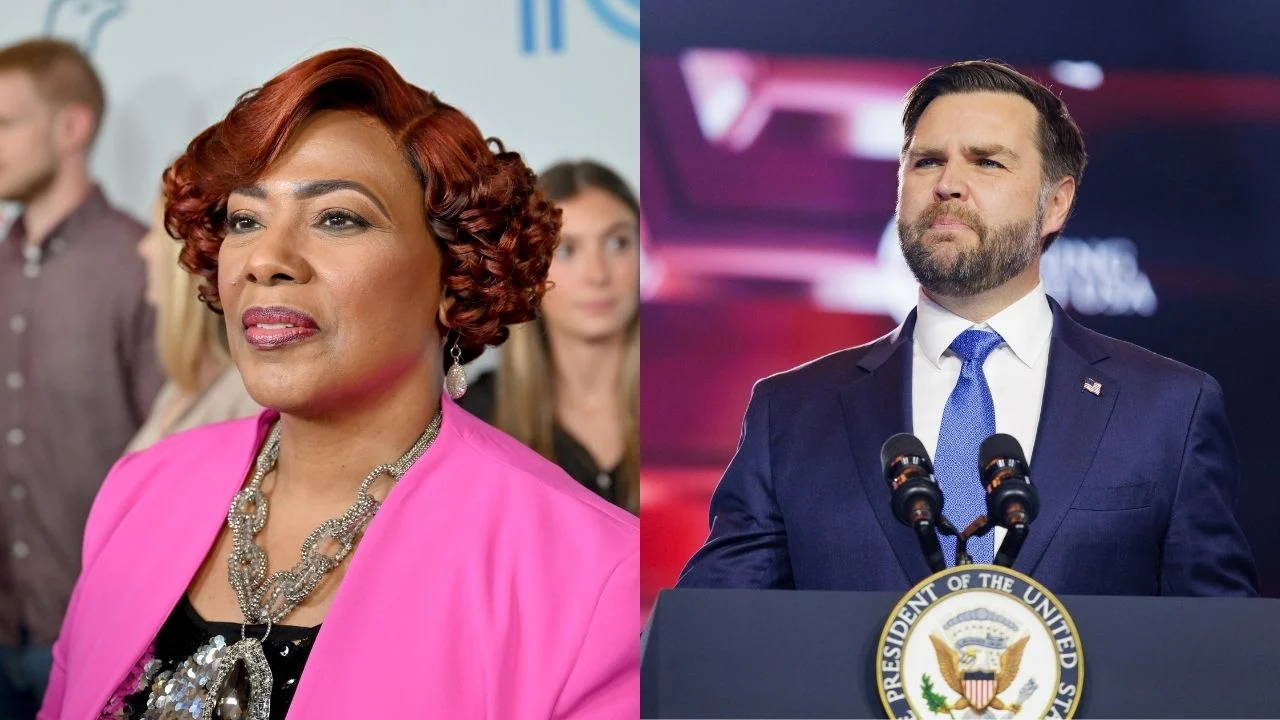
Bernice King and the Call for Accountability in America
In a recent Instagram post, Bernice King, the daughter of the renowned civil rights leader Martin Luther King Jr. and Coretta Scott King, made headlines by addressing a critical issue often swept under the rug—the accountability of whiteness in America. Her comments came in light of remarks made by Vice President JD Vance, who, during a Turning Point USA event, claimed, “In the United States of America, you don’t have to apologize for being white anymore.” King’s response highlights a significant conversation about race, history, and justice in the contemporary United States.
The Context of Vance’s Remarks
JD Vance’s statements at the Turning Point USA conference have garnered considerable attention, particularly for their framing of discussions around race as overly burdensome for white Americans. Vance also quoted rapper Nicki Minaj, whose remarks about Black pride seemingly received a mixed reaction. Critically, Vance’s assertion that white Americans bear no responsibility for their racial identity speaks to a broader societal trend—a growing discomfort among some white individuals when confronted with discussions of racism and privilege.
King’s Challenge to the Narrative
Responding directly to Vance’s comments, Bernice King posed a pivotal question on social media: “Help me with this, in my 62 years, I don’t recall white people ever having to apologize for being white in America.” This question doesn’t just seek an answer; it challenges the prevailing narrative that frames discussions about racial accountability as an unfair burden.
King urges society to confront historical inequalities head-on, emphasizing that the disadvantages faced by people of color are rooted in a complex tapestry of systemic racism. She asserts that acknowledging these disparities is crucial for moving toward a more equitable future—one where dignity and respect are not reserved selectively.
The Broader Implications of Accountability
King articulates a profound issue: the reframing of accountability as a form of injury to those who have historically benefited from systemic advantages. This trend can be seen in dialogues where the acknowledgment of privilege is positioned as a grievance. It’s an inversion of moral responsibilities that threatens to obscure the realities of those who have faced significant material harm due to systemic inequities.
Critics of Vance’s remarks argue that this framing diverts attention from the lived experiences of individuals who continue to face the ramifications of racism and discrimination every day. For them, the current discourse is not about unfair burdens; rather, it is about the long-overdue reckoning with a history that has favored some at the expense of others.
King’s Message of Hope
After her initial post, Bernice King returned to Instagram with a message that conveyed a deeper sense of commitment. “Hope, for me, is a commitment, not a cliché,” she declared. This determination underscores her viewpoint that discussions about race and accountability must go beyond mere ideals of optimism. It’s essential to engage deeply and authentically with these issues, striving for real change rather than settling for superficial fixes.
King’s resolve serves as a reminder that hope should be grounded in concrete actions and a steadfast commitment to justice. It signifies a shift towards a collective responsibility in which all Americans must participate, fostering an environment where the dignity of every individual is upheld.
The Growing Backlash
Vance’s appearance and his follow-up comments sparked further backlash, shedding light on a troubling trend in current political discourse. As discussions about race become increasingly polarized, the tendency to prioritize the comfort of those in power over the lived experiences of marginalized populations poses a challenge to meaningful dialogue. This backlash signifies a critical moment in American society—a point at which the conversations around race need to embrace both the recognition of privilege and the advocacy for justice.
By engaging with these complex issues, leaders like Bernice King play a vital role in steering the conversation towards accountability, healing, and ultimately, a more inclusive society. They remind us that the path to true equality requires both acknowledgment of past injustices and a commitment to rectify them moving forward.