


The Global Media and Entertainment Market: An In-Depth Analysis
1. Market Overview
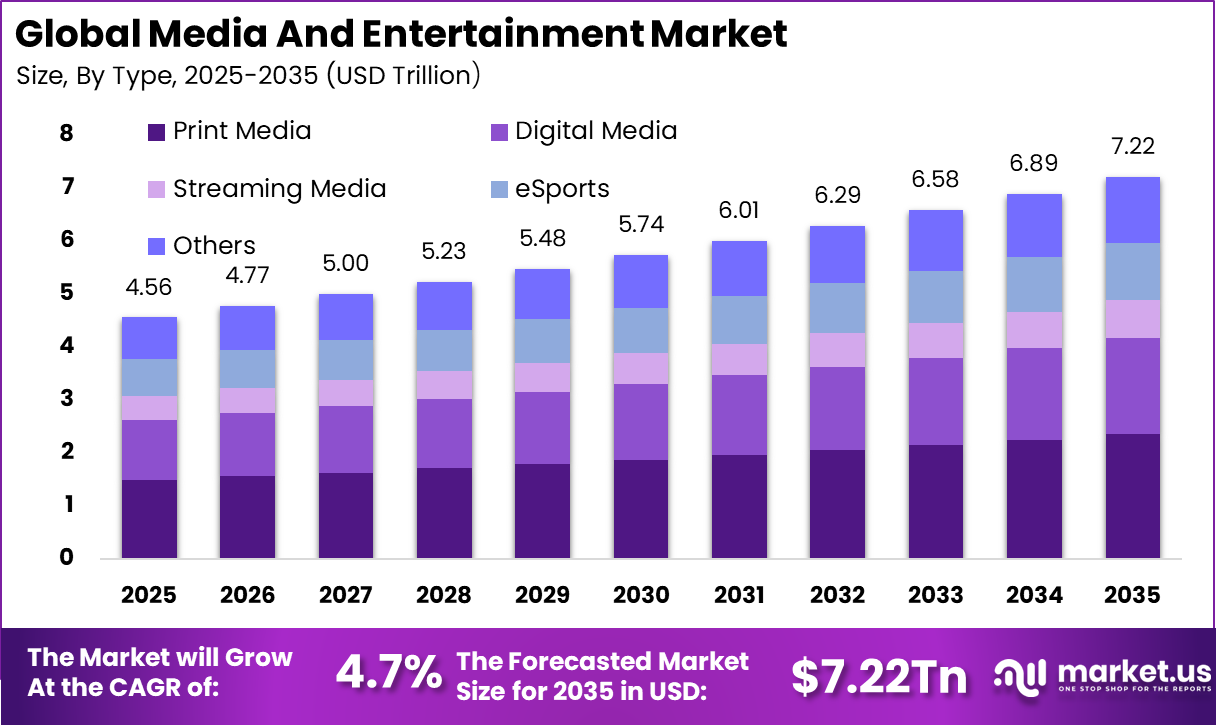
The Media and Entertainment Market is set for tremendous growth, projected to increase from USD 4.56 trillion in 2025 to nearly USD 7.22 trillion by 2035, reflecting a CAGR of 4.7%. North America leads this expansive sector, boasting over 37.1% of market share, translating to roughly USD 1.69 trillion in revenue. This domination can be attributed to the region’s prowess in content creation, digital media monetization, and streaming services.
2. Scope of the Market
The media and entertainment industry encapsulates the creation, distribution, and consumption of content across various traditional and digital platforms. The segments included in this market span film, television, music, gaming, streaming services, publishing, and live events. With the rapid adoption of digital technology, consumer engagement with media has shifted significantly. Access to content is now prevalent across multiple devices, mainly through on-demand platforms.
3. Driving Forces Behind Market Growth
One of the most significant drivers of market growth is the widespread adoption of digital streaming services, which have surprisingly attracted consumers towards on-demand content. Flexible access to a plethora of content types has drastically reduced reliance on scheduled programming, fostering a surge in digital convenience that supports robust market expansion.
Digital Media Revenue
Projected digital media revenue is expected to soar beyond USD 1.08 trillion by 2025, accounting for approximately 40% of total industry revenue. Streaming video services are anticipated to generate over USD 196 billion, illustrating a 13.2% year-on-year increase.
Advertising and Engagement
Global media advertising expenditure is also forecast to reach an impressive USD 974 billion in 2025, with over 62% derived from digital platforms. Notably, average media consumption has risen to 7.8 hours per day, alongside a burgeoning prevalence of AI-generated content, which now constitutes 14% of all digital media published online.
4. Market Segmentation
By Type: Print Media
Despite the digital shift, print media continues to capture about 32.7% of the industry. Newspapers, magazines, and other printed formats remain cherished for in-depth analysis and local coverage. While digital channels flourish, niche publications are increasingly important for targeted engagement.
By Revenue Model: Subscription
The subscription revenue model is another key segment, contributing approximately 43.6% to industry revenues. This model allows users to access content on a regular basis, often making it more appealing than one-off purchases. Many providers are enhancing subscription offerings with exclusive content and ad-free experiences.
By Device Platform: Smartphones and Tablets
Smartphones and tablets dominate the device platform landscape, representing 40.8% of consumption. These portable devices offer users the flexibility to access various forms of media—from video to games—without the constraints of traditional setups like TVs or PCs.
5. Regional Analysis: North America
North America stands as a powerhouse within the media landscape, holding 37.1% of the global market share. Key factors for this dominance include high internet usage, widespread digital payment adoption, and access to numerous connected devices.
United States Market Insights
The U.S. market alone is valued at approximately USD 1.43 trillion, growing at 3.7% annually. Strong consumer spending, alongside a significant volume of content production and exports, positions the U.S. as a leader in shaping global content trends.
Noteworthy Developments
In January 2026, Warner Bros. Discovery underscored the region’s shift in dynamics by amending its agreement with Netflix. Such consolidations highlight ongoing trends towards the merging of traditional media giants with booming digital platforms.
6. Drivers and Challenges
Drivers
Rapidly evolving consumer preferences towards high-quality content underscore the market’s expansion. Organizations are actively investing in digital distribution strategies and immersive experiences to meet these growing demands. This evolution is supported by high-speed internet and a plethora of user-friendly devices.
Restraints
Conversely, challenges remain, particularly regarding the monetization of content in an increasingly fragmented market. Competing against larger entities can be difficult for smaller companies. Regulatory constraints and copyright issues further complicate these challenges.
7. Emerging Opportunities
Emerging trends offer new avenues for revenue through personalized content delivery supported by predictive analytics. Interactive technologies—such as virtual and augmented reality—are also making strides, promising to enhance audience engagement.
Innovations in Monetization
A rise in innovative monetization strategies—like subscription bundles and micro-transactions—continues to reshape the landscape.
8. Future Growth Factors
The growth trajectory of the media and entertainment market is supported by evolving digital infrastructure and a consistent uptick in screen time. The demand for diverse content and interactive experiences propels further investment in creative production and technological advancements.
Final Insights
As the global audience expands and media consumption deepens, the dynamics of this industry will continue to thrive, offering abundant opportunities for both established players and newcomers alike.