


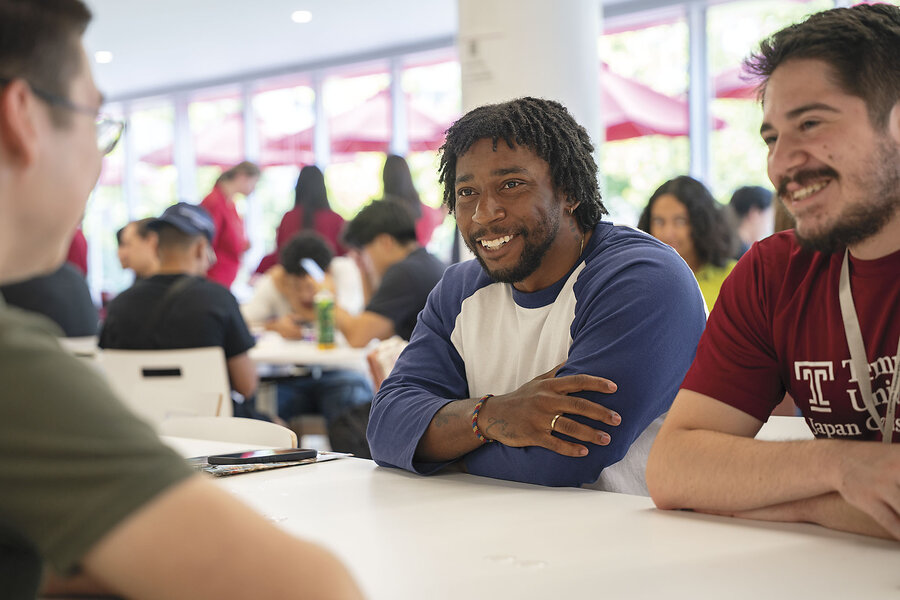
Navigating New Horizons: The Journey of Tremaine Collins in Tokyo
In the midst of the sweltering heat of an August day, Tremaine Collins finds himself at Oku train station in Tokyo. Standing on the bustling platform, he navigates the modern world of technology by punching a code into his smartphone to pay for his ticket. This central hub in the Kita district pulsates with life, a convergence point for commuters heading to various corners of one of the world’s most vibrant metropolises.
Dressed in casual blue jeans, stylish silver low-top shoes, and a multi-hued plaid shirt, Tremaine presents a blend of Western fashion and personal flair. The gold necklace glinting against his white tank top serves as a subtle reminder of his individuality in a city where Westerners remain relatively uncommon. “I’m not here because I’m here on vacation,” he asserts. “I’m here because this is a goal that I always wanted to achieve.”
A Unique Experience
Tremaine begins his first year at Temple University Japan—a campus with a diverse mix of about 3,000 students, where half hail from the United States. Unlike typical semester abroad programs, he is enrolled full-time in a four-year undergraduate program. His presence stands out: he is one of only two Black men on the platform and among the few in Japan. This makes his journey even more noteworthy given the statistics surrounding study abroad participation among Black males in the U.S.
Remarkably, in the 2023-2024 school year, nearly 300,000 Americans studied abroad, yet only 6% identified as Black. Among male students, Black men comprised a mere 2%. “This is the $20 million question, literally,” exclaims Tonija Hope, who leads the study abroad program at Howard University. The rarity of Black men studying abroad is not only indicative of personal choices but also reflects broader systemic issues.
The Impact of Studying Abroad
Tremaine’s ambition to explore and learn stemmed from a childhood in Lorain, Ohio. Growing up in a steel town, he found solace in interests often ridiculed by peers. Fascinated by Pokémon and anime, he distanced himself from sports and hip-hop culture, craving unique experiences. “My dad wasn’t really in my life like that. It was just my mom and my grandma,” he shares, recalling feelings of neglect and isolation that spurred him to seek self-improvement and greater understanding of manhood.
After graduating high school, Tremaine made a steadfast decision that shocked his family: he enlisted in the Air Force, landing in Montana. The military experience opened new avenues for growth, catalyzing his journey toward higher education. Gaining acceptance to schools in Europe was a significant achievement, yet his time at the American University of Paris became complicated after a disturbing encounter with French police. That experience reshaped his outlook and fueled a resolve: he must return to Japan.
Overcoming Challenges
Confronting failure and opposition, Tremaine sought a place that would not only nurture his academic ambitions but also provide a sense of community. He recalls, “I think if you have the opportunity to explore outside of yourself, and if you want to not do it and blame it on fear, I think you’re doing yourself an injustice.” Such determination drives him forward, even as he acknowledges the barriers faced by Black students interested in studying abroad. Margery Ganz, a professor, published a paper identifying the “4 F’s” that contribute to lower Black student participation: family, finances, fear, and faculty.
Understanding that families can sometimes discourage such endeavors due to unfamiliarity with international travel or the value of studying abroad, Tremaine and experts alike emphasize the need for structured outreach. The added financial burden is another palpable obstacle, impacting decisions for many Black students who may lack the resources enjoyed by their white counterparts.
Navigating Racism and Isolation
Fear of racism abroad is another significant concern. The prospect of enduring microaggressions or discrimination in a foreign environment can deter potential students. Experiences shared by other Black students studying abroad echo Tremaine’s sentiments, underscoring the frequently isolating experience of being one of only a few Black individuals in predominantly white spaces.
As Tremaine embarks on his classes at Temple University Japan, he takes strides to assimilate, participating in welcome week activities and engaging with fellow students. The language barrier presents an exciting yet daunting challenge, motivating him to take Japanese elements classes. “Sometimes, I feel you’ve got to step away from the culture to find out what you actually like,” he expresses, emphasizing the importance of broadening one’s experiences beyond familiar comforts.
The Role of Leadership
Throughout his journey, Tremaine has garnered support from programs aimed at empowering Black men and addressing the unique barriers they face. Ruby Maddox, who founded Leaders of the Free World, exemplifies the transformative power of similar initiatives. After her experiences in Ghana, she sought to expand access to international experiences for young Black men, aiming to show them the potential that lies beyond their immediate surroundings.
Dr. Ham, involved with leading travel groups to Africa, shares a similar vision. His commitment to elevating African American representation in international affairs reflects a growing dedication to bridging the gap in study abroad participation rates. Both leaders highlight the importance of communal backing and mentorship, crucial elements for young Black men venturing into unfamiliar territories.
Embracing New Beginnings
As Tremaine continues to navigate life in Tokyo, he strikes a balance between academic pursuits and cultural exploration. He reflects on the importance of resilience and self-discovery: “I think my older self is going to be proud of my younger self.” His journey stands as a testament to the possibilities that lie ahead when individuals step outside their comfort zones, embracing the global stage with open hearts and minds.
In the vibrant streets of Tokyo, Tremaine Collins symbolizes a new narrative—one where individuality, ambition, and cultural exploration converge to break barriers and redefine Black male representation in educational spaces abroad.