


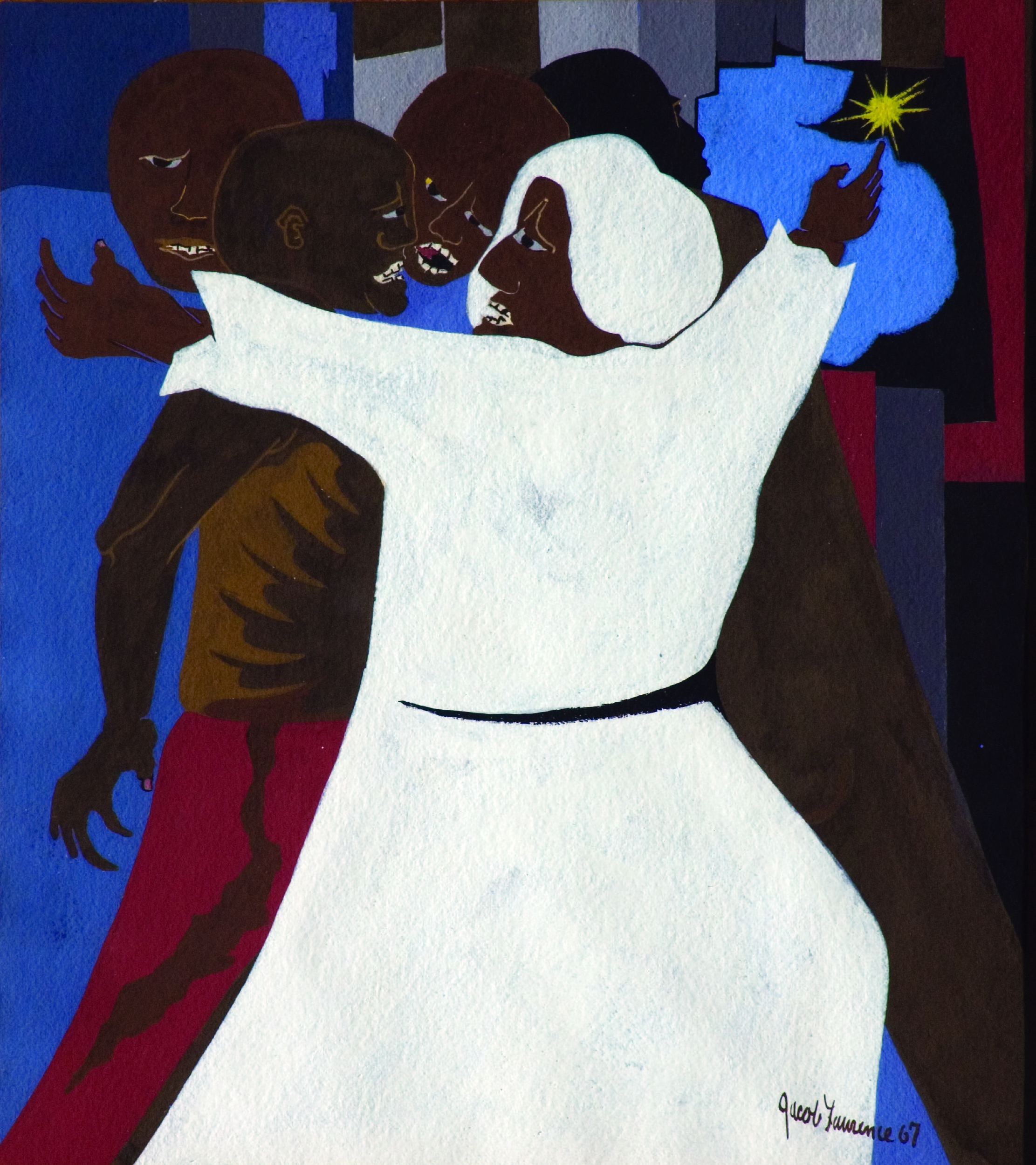
Unveiling the Depths of African American Modernism: Jacob Lawrence at Kunsthal KAdE
A Landmark Retrospective
The upcoming exhibition at Kunsthal KAdE in Amersfoort, Netherlands, titled “African American Modernist,” showcases the monumental work of Jacob Lawrence, marking his first European retrospective. Running from September 27, 2025, to January 4, 2026, this exhibition features a stunning collection of seventy paintings, twenty-five drawings, and seventy-five prints that span over seven decades. This is not merely another art show; it seeks to place Lawrence in the pantheon of modernism as an equal innovator, utterly deserving of his place alongside artists like Diego Rivera and Francisco de Goya.
A Bold Artistic Voice
Jacob Lawrence (1917–2000) created art deeply rooted in the Black American experience, persisting in its moral and social narratives. His work is anything but derivative; it embodies a unique voice that reclaims and redefines the concept of modernism. As viewers step into the exhibition, they are immediately engaged by the vivid colors and distinctive forms that constitute Lawrence’s artistic grammar. His signature visual style—marked by flat planes, rhythmic patterns, and geometric reductions—immediately captivates the audience and invites inquiry even before they delve into the wall texts.
Pictorial Democracy
One of the striking features of Lawrence’s work is his refusal to engage with illusionistic depth. Instead, he opts for a form of pictorial democracy, where every element—be it human figure or architectural space—holds equal visual weight. This approach compels viewers to physically experience the ethical dimensions of his art, where no single aspect outshines the others, and where hierarchy has little place. It’s a conscious choice that invites active participation, urging viewers to navigate the artistic landscape without preconceived notions about dominance or inferiority.
Reconstructing Community Through Art
While Pablo Picasso is known for fracturing forms and bodies, Lawrence reconstructs social bodies through his art. His flattened perspectives and the use of intense color create a visual ethics that narrates the complexities of work, war, and worship. This distinction is crucial; where theorists like Frantz Fanon engage with the concept of fractured identities in colonial contexts, Lawrence infuses these abstractions with dignity and presence, grounding them in lived experiences. His work resonates with W.E.B. Du Bois’s notion of double consciousness, offering viewers dual planes of perception—one rooted in individuality and the other in collective experience.
Migration Series: A Journey Through Time
One of the highlights of the exhibition is the Migration Series, composed of sixty panels created between 1940 and 1941, when Lawrence was just twenty-three years old. This sequence chronicles the mass movement of Black Americans from the oppressive Jim Crow South to more liberated northern cities. Kunsthal KAdE presents a rare opportunity to view pieces from this series that are normally separated between the Museum of Modern Art (MoMA) and the Phillips Collection. Witnessing them together heightens the impact and deepens the narrative, enabling viewers to feel the collective journey of a community striving for freedom and justice.
Iconic Imagery: A Plan to Escape
Among the standout works in the exhibition is A Plan to Escape (Harriet and the Promised Land) from 1967. This piece encapsulates the urgency and peril associated with the abolitionist movement led by Harriet Tubman. Here, Tubman appears suspended in a vibrant blue sky, her arms outstretched in a gesture that defies grounding. The radical flattening in this artwork translates her historical journey into a transcendent moment, depicting both aspiration and desperation. The ambiguity of her position—neither clearly rising nor falling—compels the viewer to reflect on her precariousness and the urgency of her mission.
Engaging Viewers Emotionally
Before the work, viewers are confronted not just with a visual experience, but with a moral and emotional one. The intense chromatic choices and spatial ambiguities Lawrence employs do more than capture the eye; they compel the viewer to participate in the narrative unfolding before them. Audiences find themselves grappling with the weight of Tubman’s legacy, pondering the real implications of freedom, sacrifice, and the paths taken toward liberation.
A Celebration of Legacy
The African American Modernist exhibition invites the art community and the general public alike to reevaluate who has shaped modernism. Jacob Lawrence’s work, far from being a secondary narrative, emerges as a powerful and vital force. As viewers engage with this extensive collection, they step into a dialogue that spans generations, cultures, and ethical considerations. The retrospective serves not only as a celebration of Lawrence’s artistic legacy but also as a vital reminder of the importance of inclusivity in the art historical canon.
This detailed showcase at Kunsthal KAdE promises to be transformative, ensuring that Jacob Lawrence’s contributions to art are acknowledged and celebrated in the broader discourse of modernist movements.